Toy Warehouse
Company
Shop By Category
T&Cs
Shop Online
  • Box contents listed
  • Free tracked Australia-wide delivery over $150
  • 14-day returns

13 in 1 Solar Robot Kit | Solar powered robot toy | Robot building kit for kids

13-in-1 Solar Robot Kit

$59.99 $71.99 Save $12
  • Runs On Daylight
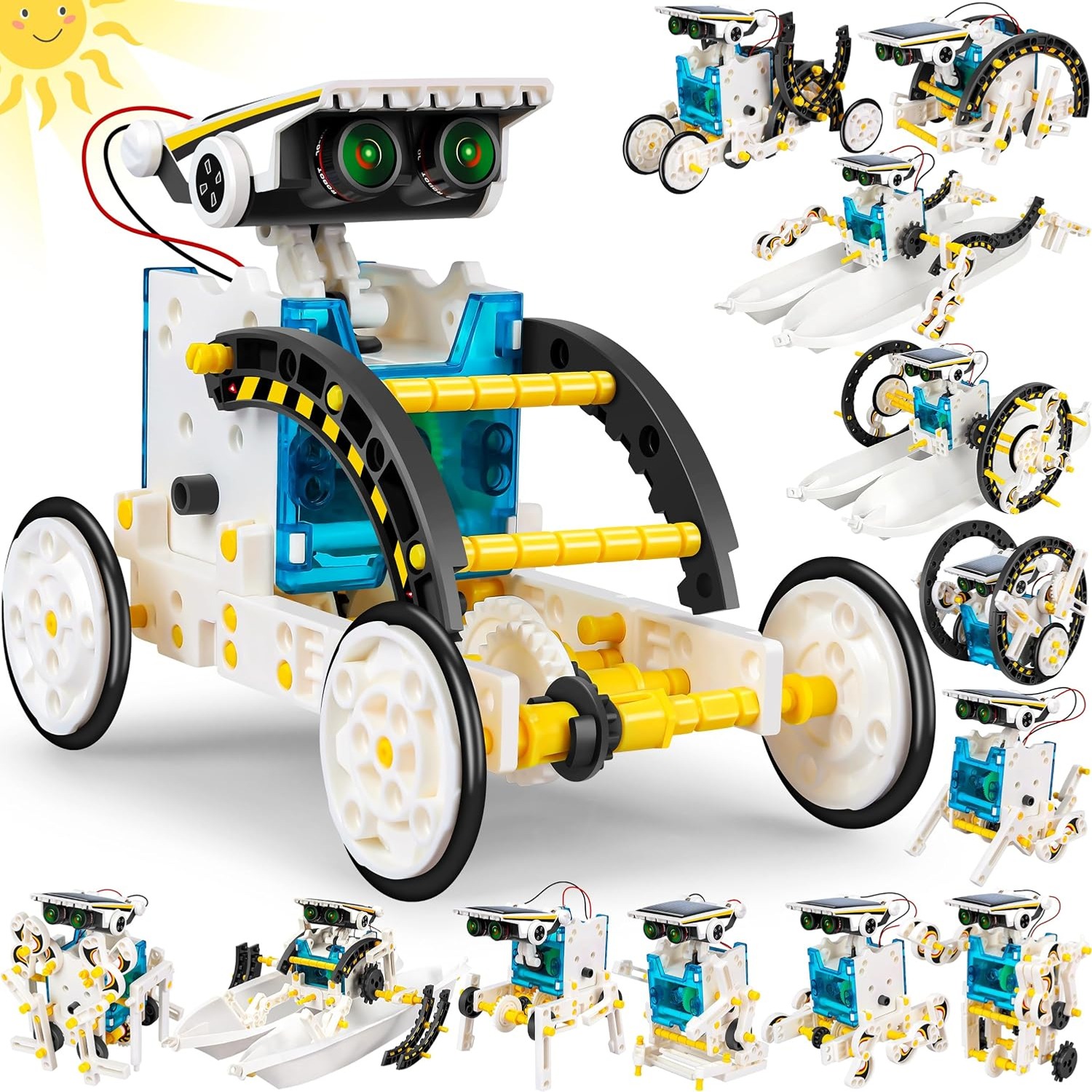
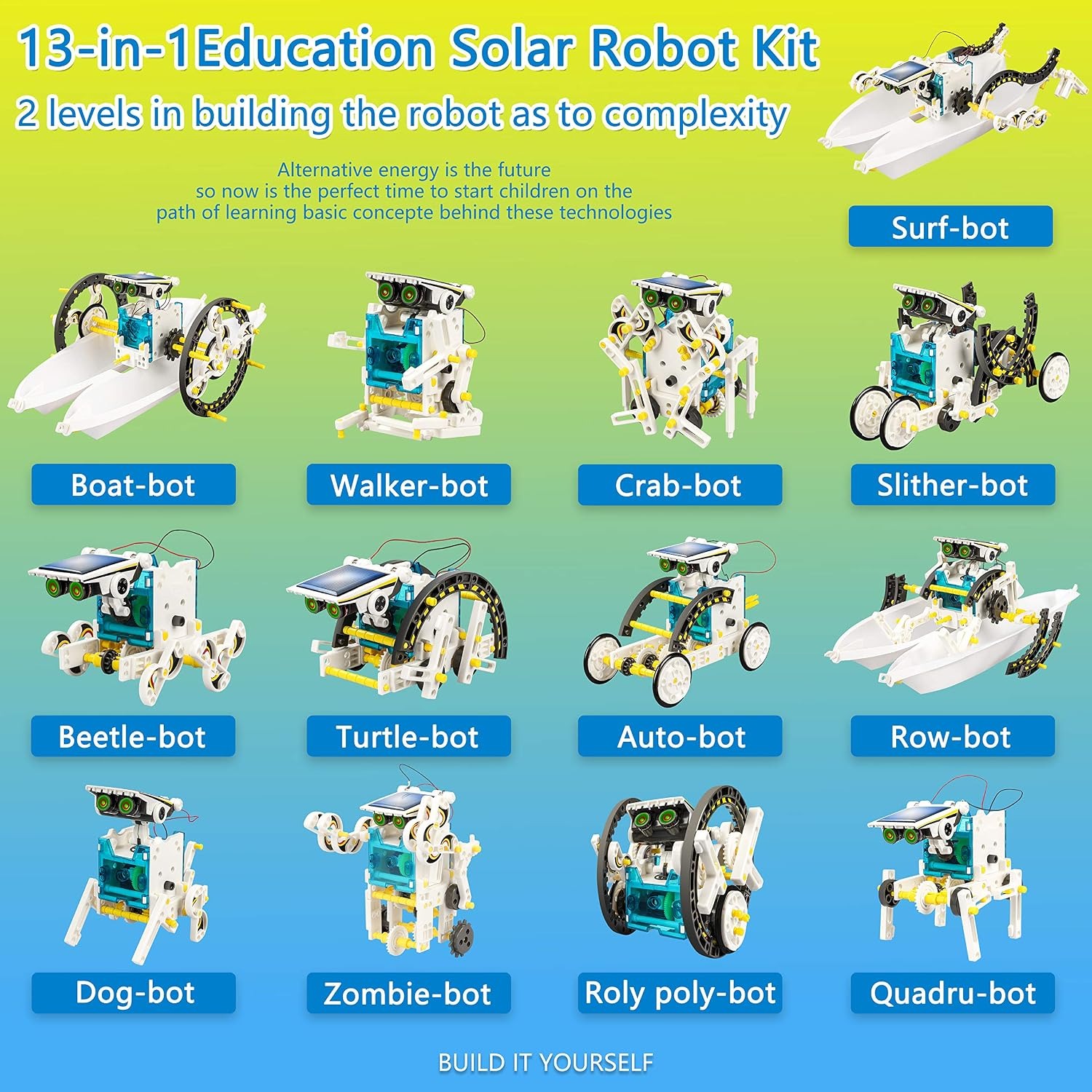
  • Thirteen Builds
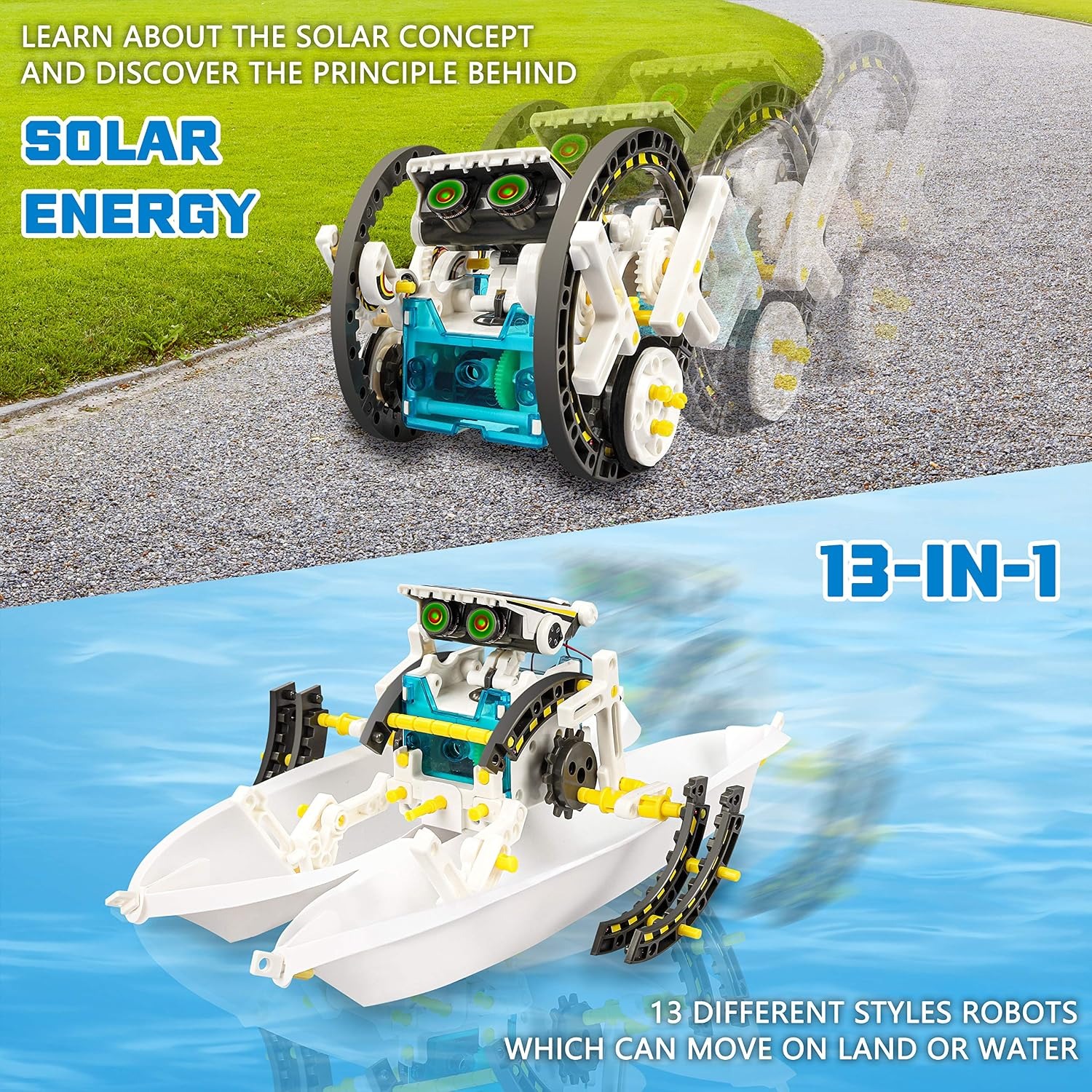
  • Land And Water
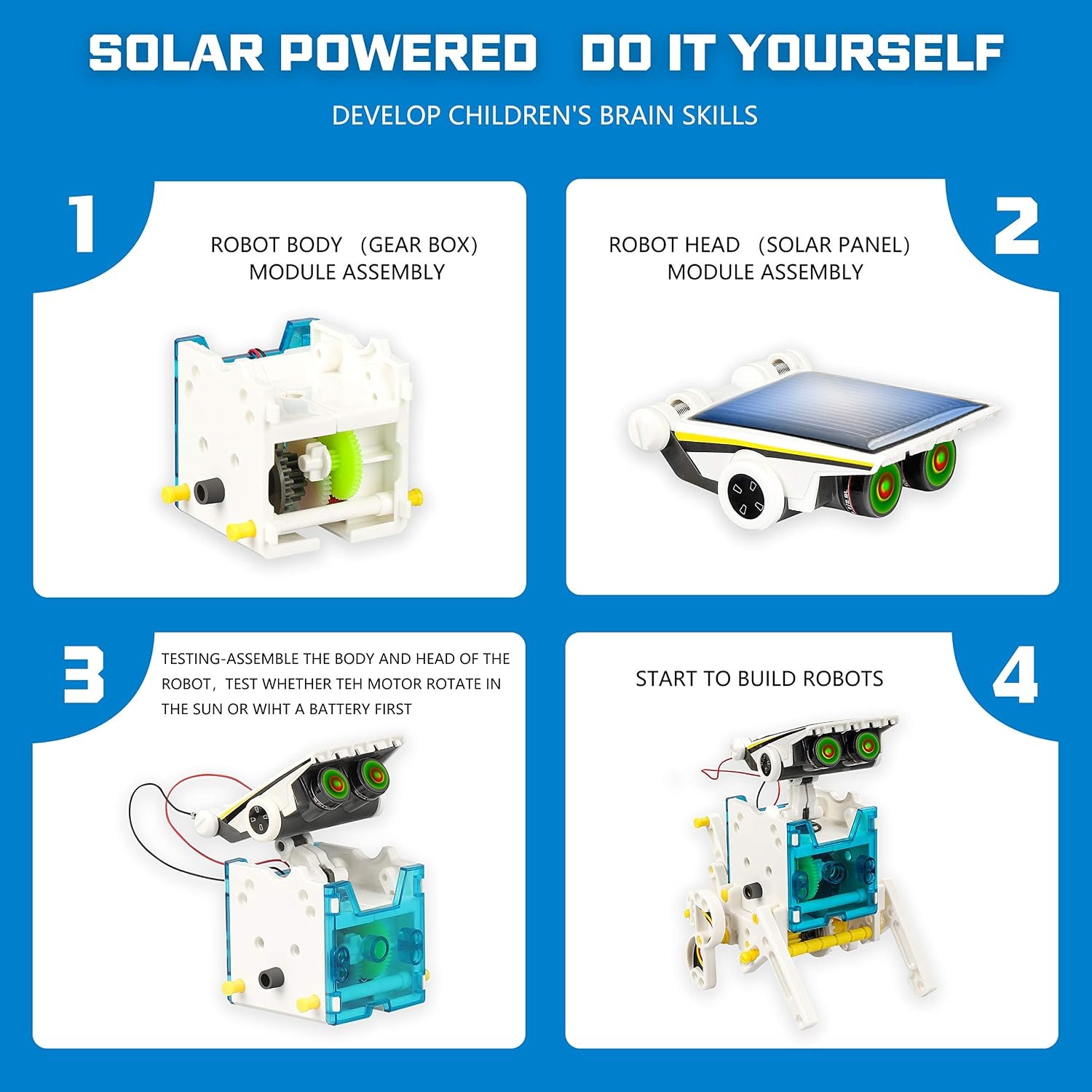
  • Step By Step

Price: $59.99 $71.99

  • Free tracked Australia-wide delivery on orders $150+, otherwise a flat $15
  • Pay by card or PayPal, handled by the payment provider
  • 14 days to change your mind, plus your statutory rights
Product specifications
BrandBottleboom
Set Name13-in-1 Solar Robot Kit
Model Number2115
ManufacturerBottleboom
Manufacturer Part Number2115
Manufacturer Recommended Age4 to 12 years
Age Range DescriptionKid
Educational ObjectiveCreative skills, imagination development, problem solving skills, STEM
ThemeRobots
Material TypePlastic
Unit Count13 Count
Assembly RequiredNo
SizeSmall
Item Dimensions5 x 5 x 5 cm
Shipping & returns

Tracked delivery anywhere in Australia. It is free on orders of $150 or more, and a flat $15 below that.

If it is not right for you, send it back within 14 days of delivery in resaleable condition and we refund the price you paid, including standard delivery. That is a voluntary policy we offer on top of your legal rights. You cover the cost of returning it unless the item is faulty.

If it arrives faulty, damaged or not as described, we put it right at no cost to you under the Australian Consumer Law and the Competition and Consumer Act 2010, return postage included.

Shipping details · Refunds and returns

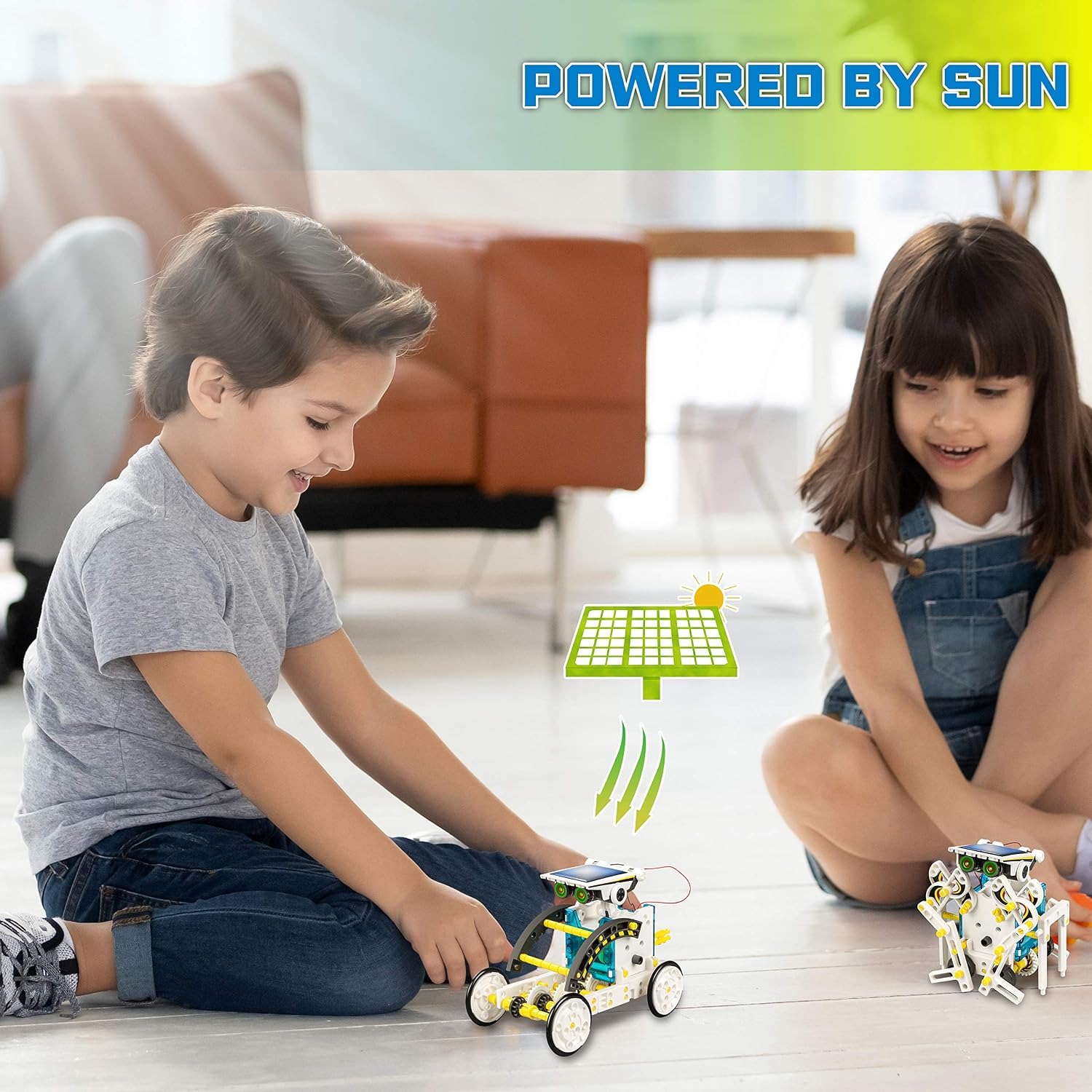
Runs On DaylightA small solar engine powers the builds, so there are no batteries to buy or replace.
Thirteen BuildsSplit and reassemble the same parts into thirteen different robots.
Land And WaterSome models roll across the floor, others are made to move on water.
Step By StepAn illustrated manual walks kids through each build from easy to harder.

One box, thirteen builds, and a 13 in 1 solar robot kit that runs on nothing but daylight.

Snap-together gears, plates, tyres and shafts let kids assemble robots that move on land or water, powered by a small solar engine instead of batteries.

Build thirteen different robots from one set of gears, plates, tyres and shafts, then take them apart and start again.

A solar engine drives the models, so the toy teaches kids about renewable power while they play.

Models are designed to move on land or on water, which keeps the building interesting past the first few projects.

The step by step manual starts simple and gets harder, so a child can grow into the harder builds over time.

Parts come apart cleanly after each build, making this a kit that gets used again rather than glued down once.

13-in-1 Solar Robot Kit

Most robot toys do one thing. You open the box, you build the robot, and then it sits on a shelf. This kit works differently. The same pile of gears, plates, tyres and shafts can be arranged into thirteen separate machines, and each one comes apart again when your child is ready for the next challenge. That single design decision is what keeps the box in use for months instead of an afternoon.

13-in-1 Solar Robot Kit

The power source is the other difference. Instead of a battery compartment, there is a small solar engine. Take a build outside or put it near a bright window and it starts to move. No batteries to hunt for, no charging cable, and a simple, physical lesson in where energy comes from. Kids work out very quickly that shade slows things down and sunlight speeds them up, which is a better science lesson than any worksheet.

13-in-1 Solar Robot Kit

Builds are grouped from simple to complex. The early models have fewer parts and go together in a few minutes, which matters for younger builders who need an early win. Later models ask for more patience and better reading of the diagrams. Some of the thirteen are made to travel across the floor, and others are designed to move on water, so the kit is not just thirteen variations on the same wheeled chassis.

13-in-1 Solar Robot Kit

The manufacturer lists the recommended age as 4 to 12 years, which is a broad window on purpose. A four or five year old will usually want an adult sitting alongside them, turning pages and holding pieces steady. By eight or nine most kids are working through builds on their own and only asking for help when a gear will not seat. Older children tend to race through the manual and then start modifying builds, which is exactly the point.

13-in-1 Solar Robot Kit

Pieces are moulded plastic, sized for small hands, and press together without tools. Because nothing is glued and nothing is permanent, mistakes cost nothing. A child can pull a model apart, check the diagram, and try again. That loop of build, test, fix and rebuild is the part of STEM that actually sticks, and it is far easier to teach with a kit like this than with a screen.

Not sure yet? That is fine.

A toy has to suit the child it is for, and you cannot always judge that from a photograph. If it is not right for you, send it back within 14 days of delivery in resaleable condition and we refund the price you paid, including standard delivery. That is on top of your Australian Consumer Law rights if anything arrives faulty.

If it turns up faulty, damaged or not as described, that is on us. The Australian Consumer Law and the Competition and Consumer Act 2010 covers you, and we pay the return postage. Read the full detail on our refunds and returns page, or ask us anything before you order.

Frequently Asked Questions

What exactly is in this kit?

It is a construction set with the moving and connecting parts needed to build robot models, including gears, plates, tyres and shafts, plus a small solar engine. A step by step user manual shows how to assemble each of the thirteen designs. The parts are shared across the builds, so you make one model at a time.

Can you really build thirteen separate robots?

Yes, but one at a time. The manual covers thirteen different models, and you split the finished build back into parts before moving on to the next. That reuse is what makes it one of the better value building toys for children rather than a single-model kit.

How does the solar power work?

A small solar engine converts light into movement for the model. Put the finished robot in bright sunlight or under a strong light source and it will start to move. In shade or dim indoor light it will slow down or stop, which is part of the lesson.

Does it need batteries?

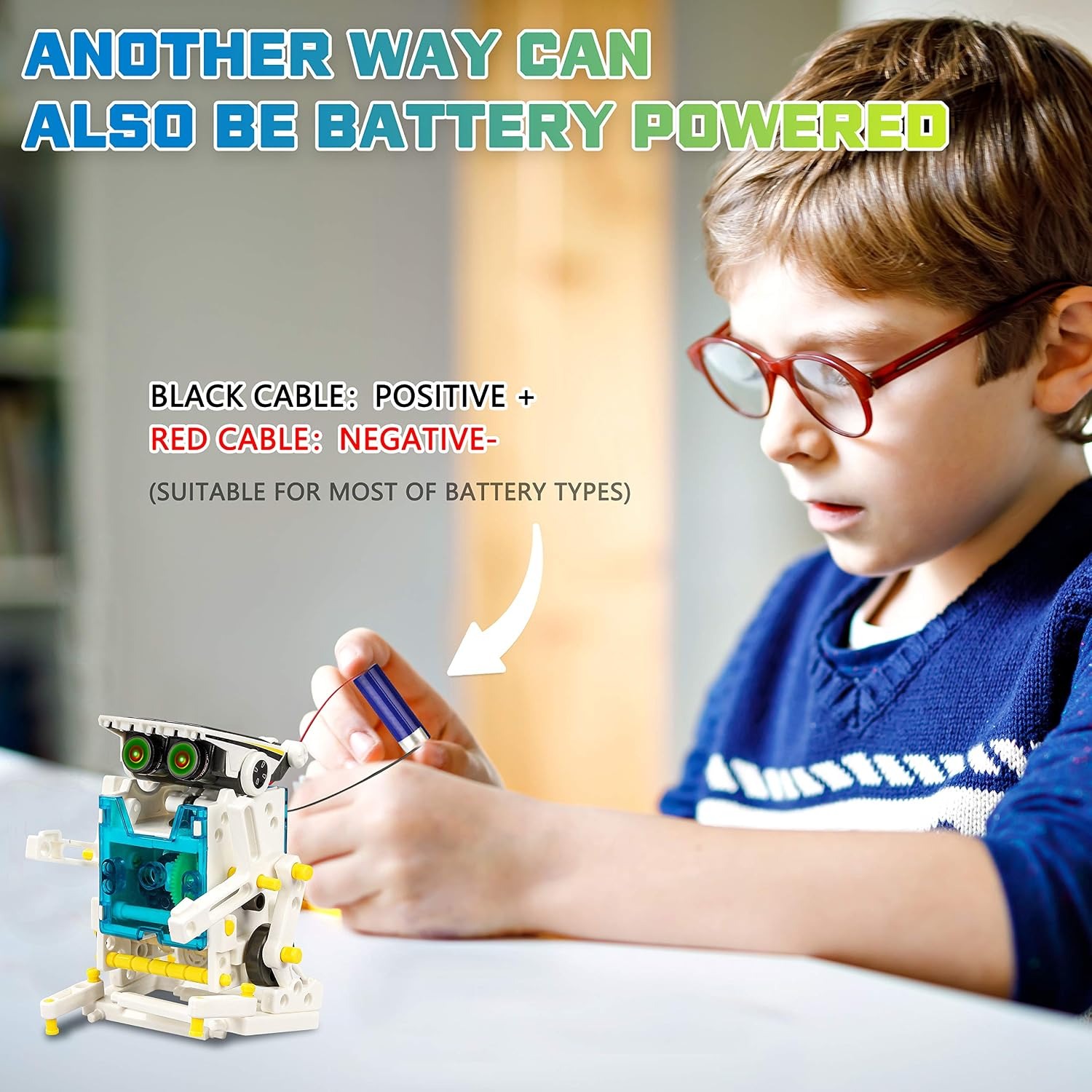
No. The kit is powered by its solar engine, so there is nothing to buy or replace. That makes it a genuinely useful option if you are looking for no battery toys for kids.

What age is this suitable for?

The manufacturer lists the recommended age as 4 to 12 years. Younger children in that range will usually need an adult to help read the diagrams and seat the trickier parts. From around eight, most kids manage the builds independently.

Is this good for an eight year old?

Eight sits right in the sweet spot. A child that age can follow the illustrated steps, handle the smaller gears, and work through the harder models with only occasional help. It is one of the more popular picks when people search for a robot kit for 8 year olds.

Will a four year old manage it?

Four is the bottom of the stated range, so treat it as a shared activity rather than a solo one. An adult can do the fiddly assembly while the child places parts and tests the model in the sun. The early, simpler builds are the ones to start with.

Is it suitable for girls as well as boys?

Completely. There is nothing gendered about building, problem solving or solar power, and the kit is sold for all children in the age range. It works just as well as robot toys for girls as it does for anyone else.

What are the parts made from?

The listing specifies plastic as the material type. The pieces are moulded to press together without tools or glue. Beyond the plastic material type, no further material detail is specified in the maker's details.

Does it need to be assembled before my child can use it?

The product details state no assembly is required out of the box, meaning the kit arrives ready to open and start building. The building itself is the activity, so your child does the assembly as part of play. Nothing needs setting up by an adult first.

How long does one build take?

The early models go together in roughly fifteen to thirty minutes for most children. The later, more complex builds can take an hour or more, especially the first time through. Pace depends heavily on age and how much help is on hand.

Do any of the models actually float?

Some of the thirteen designs are made to move on water rather than land. Those are best tested in a bath, a shallow tub or a paddling pool where you can keep an eye on them. Dry everything off afterwards before storing.

Can it be used indoors?

Yes, as long as there is enough light. Near a bright window on a sunny day usually works, and a strong lamp can help. Dim indoor light will not give the solar engine much to work with, so outdoors is still the best test.

What happens on cloudy days?

Movement slows down or stops when light is weak. That is not a fault, it is how a solar powered robot toy behaves. Overcast days are actually useful for showing kids the direct link between light and power.

Is it a good STEM toy or just a toy?

The stated educational objectives are creative skills, imagination development, problem solving and STEM. Children read diagrams, follow sequences, troubleshoot when something does not move, and learn about renewable power. That is real hands on learning, not a label.

How big are the finished robots?

The item dimensions listed are 5 x 5 x 5 cm, which refers to the item measurement in the maker's details rather than every finished build. Models vary in size depending on which of the thirteen you assemble. Exact finished model dimensions are not specified by the maker.

How much does the kit weigh?

The product weight is not specified by the maker. It is a small plastic construction set, so it is light to handle and easy to carry outside. If weight matters for your purchase, contact us before ordering.

What colour is it?

Colour is not specified by the maker. Product photos give the clearest indication of how the set looks. We do not list a colour we cannot confirm.

Where is it made?

The country of origin is not specified by the maker. The brand listed is Bottleboom and the model number is 2115. We will not state a manufacturing origin we cannot verify.

Are small parts a choking risk?

The kit contains small components like gears and shafts, so supervise young children closely and keep the pieces away from children under 3 and pets. The stated recommended age starts at 4 years. Use your own judgement about whether your child still mouths small objects.

How do I clean it?

Wipe the plastic parts with a dry or slightly damp cloth and let everything dry fully before storage. Keep the solar panel clean so it can pick up light properly. Avoid harsh cleaners, which can dull or damage the plastic.

How should the pieces be stored?

Keep everything in the original box or a sealed container with a lid. Losing a single gear can block a build, so a dedicated container is worth it. Many families keep the manual in the same box.

What if a part breaks or goes missing?

Get in touch and let us know which piece and which build it affects. Keeping the original packaging helps us identify the exact part. We will look at the options available for your order.

Does it come in gift packaging?

It is supplied in retail packaging with a single kit per pack. It presents well as a gift without extra wrapping. Keep the box intact if you plan to store parts in it long term.

Is this a good gift idea?

It is a strong choice for birthdays and Christmas, especially for a child who already likes building things. Among STEM gifts for kids it has an advantage in that it does not get finished and forgotten after one sitting. The thirteen builds give it a long tail.

Can two children share one kit?

Yes, and it often works better that way. One reads the manual while the other handles the parts, which turns it into a cooperative project. A single set only builds one model at a time, so sharing is naturally built in.

Can parents join in?

Absolutely, and with younger builders you probably should. Working through a harder model together is a good way to spend a rainy afternoon away from screens. Older kids usually only want you nearby for the stuck moments.

Do I need any tools?

No tools are needed. The pieces press and slot together, and they come apart again by hand when a build is finished. Keep a small container handy for loose parts while building.

How long does delivery take and can I return it?

Delivery times depend on your country and are shown at checkout. Returns follow our standard policy, so keep the packaging and the parts complete until you are sure. Contact us before sending anything back so we can guide you through it.

What if it is not right for my child?

If the kit turns out to be too advanced, too simple, or just not what you pictured, get in touch with us. Keep it unused in its packaging where possible and tell us what went wrong. We would rather sort out a swap or a return than have a kit sitting unopened in a cupboard.

How To Choose A Solar Robot Kit That Actually Gets Built

6 min read Toy Warehouse

The problem with most "educational" toys

Walk down any toy aisle and you will find a shelf of boxes promising to teach your child engineering. Most of them are one build. Your child opens the box on a Saturday, you spend two hours helping, the model gets finished, it goes on a shelf, and that is the end of it. The learning was real, but it lasted one afternoon and cost the same as a dozen books.

The second problem is batteries. Half the toys that move need AA cells, and the cells are always flat on the one day your kid is actually interested. Then the battery door screw strips, or the contacts corrode, and the thing stops working for reasons nobody can see or fix.

A 13 in 1 solar robot kit answers both of those. Thirteen builds from one set of parts means the box keeps giving long after the first model is done. A solar engine means it runs on daylight, which is free, always available during the day, and far easier for a child to understand than an invisible charge inside a plastic cylinder.

How a solar powered robot toy actually works

The mechanics are simple enough that a seven year old can grasp them. A small panel collects light and turns it into electricity. That electricity drives a tiny motor. The motor spins a gear, the gear turns other gears, and those gears drive wheels, legs or paddles depending on the model your child has built.

What makes this a good teaching tool is the direct, visible link between light and motion. Cover the panel with your hand and the robot slows down. Move it from a shady patch into full sun and it speeds up. There is no delay, no guessing, no abstraction. Children learn cause and effect by doing, not by being told.

It also sets up a useful conversation about renewable power without anyone having to deliver a lecture. Your child discovers for themselves that the sun can do work. That idea tends to stick in a way that a classroom poster does not.

What you get and what you build

The kit includes the moving and connecting parts a robot needs. Gears transfer power. Plates form the body and chassis. Tyres handle ground contact. Shafts hold everything in the right position and let parts rotate. A step by step user manual shows how these combine into each of the thirteen designs.

Some models are built to roll across the floor. Others are designed to move on water, which is an unusual and welcome addition. A kit where every build is a slightly different car gets old fast. Switching between land and water models keeps the thirteenth build as interesting as the first.

Crucially, every build comes apart. Nothing is glued. When a model is finished, played with and photographed, your child strips it back down and the parts go into the next project. That is the whole design philosophy, and it is why this sits above most construction toys for children on value per hour of use.

Who it suits

The manufacturer recommends ages 4 to 12 years. That is a wide band, so here is how it actually breaks down in practice.

At four and five, treat it as a parent and child project. An adult reads the manual and handles the fiddlier connections while the child places parts, identifies shapes and does the exciting bit of carrying the finished robot into the sun. Stick to the simpler early builds. Expect the attention span to run out before the model does, and that is fine.

From six to eight, children start taking over. They can follow illustrated steps, recognise which gear goes where, and troubleshoot when something does not turn. You will still get called in when a part will not seat. This is the age where the kit does its best work, because the challenge level and the ability level line up.

From nine to twelve, most kids will work straight through the manual alone and then start inventing. They will combine parts in ways the manual never showed, test what happens, and fix what breaks. That is engineering. If you have an older child who already likes building, this is one of the better engineering toys for boys and girls at this price point simply because it rewards experimentation.

How to choose between kits like this

If you are comparing several science kits for kids, a few things matter more than the marketing on the front of the box.

Count the builds, then ask whether they are genuinely different. Thirteen models that are all four wheels and a body is really one model with thirteen paint jobs. Land plus water variety is a real differentiator.

Check whether parts disassemble. Some kits use push fittings that only go together properly once. A kit that comes apart cleanly is a kit that gets built twice.

Look at the manual. Clear, illustrated, numbered steps are the difference between an independent child and a frustrated one. A good manual is half the product.

Think about the power source honestly. Solar is excellent for teaching and for avoiding battery hassle, but it does need light. If your child will mostly be building in a dim lounge room in winter, factor in that testing may need to happen near a window or outside.

Finally, consider how much adult time you can give. A kit that needs constant help is a kit that sits in a cupboard once the first weekend is over. Match the difficulty to the child, not to the child you hope they will be in two years.

Getting the most out of it

Set up a dedicated space before you start. A tray or a shallow box stops gears rolling off the table and under the couch, which is where kits go to die. Keep the manual in the same place as the parts.

Build in order. The manual goes from simple to complex for a reason. Starting with the hardest model because it looks coolest is the fastest route to a kid who gives up.

Test outside. Indoor lighting rarely gives the solar engine much to work with, and a robot that barely twitches is disappointing. Full daylight makes it obvious the thing works, which is the payoff your child is building towards.

Encourage modifications once the manual is done. Ask what happens if you swap a gear for a bigger one, or move the wheels further apart. There are no wrong answers and nothing to break, because everything comes apart again.

Looking after it

Care is simple. Wipe parts with a dry or slightly damp cloth and let them dry fully before putting them away. Keep the solar panel clean, because dust and fingerprints cut how much light it can collect.

Dry the water models properly after use. Store everything in the box or a lidded container, since a single lost gear can block a build. Avoid leaving the kit in a hot car or baking in direct sun for hours at a time, which is hard on plastic over the long run.

The short version

This is a plastic construction set that builds thirteen different robot models from one shared pile of gears, plates, tyres and shafts, powered by a small solar engine instead of batteries. Models move on land or on water. The manual runs from easy to harder, and everything disassembles for reuse.

The recommended age is 4 to 12 years. Younger children need an adult alongside them. From around eight, most kids build alone. It is a solid pick if you want screen free toys for kids that keep working past the first afternoon, and a good gift for a child who already likes taking things apart to see how they go together.

Browse the shop

Not sure if it suits your child's age?

Tell us how old they are and how much help they will have, and we will give you a straight answer about whether this kit fits.

Ask us a question

Page summary

The Bottleboom 13-in-1 Solar Robot Kit is a plastic construction set for children that builds thirteen different robot models from one shared set of parts, including gears, plates, tyres and shafts. Models are designed to move on land or on water and are driven by a small solar engine rather than batteries. A step by step illustrated manual guides builds from simple to more complex, and parts disassemble for reuse. The manufacturer recommends ages 4 to 12 years. Model number 2115, UPC 793610399212, material listed as plastic, unit count 13, single pack, no assembly required out of the box. Colour, country of origin and product weight are not specified by the maker.