Toy Warehouse
Company
Shop By Category
T&Cs
Shop Online
  • Box contents listed
  • Free tracked Australia-wide delivery over $150
  • 14-day returns

Flower Garden Building Set | Flower building toy | Garden construction toy

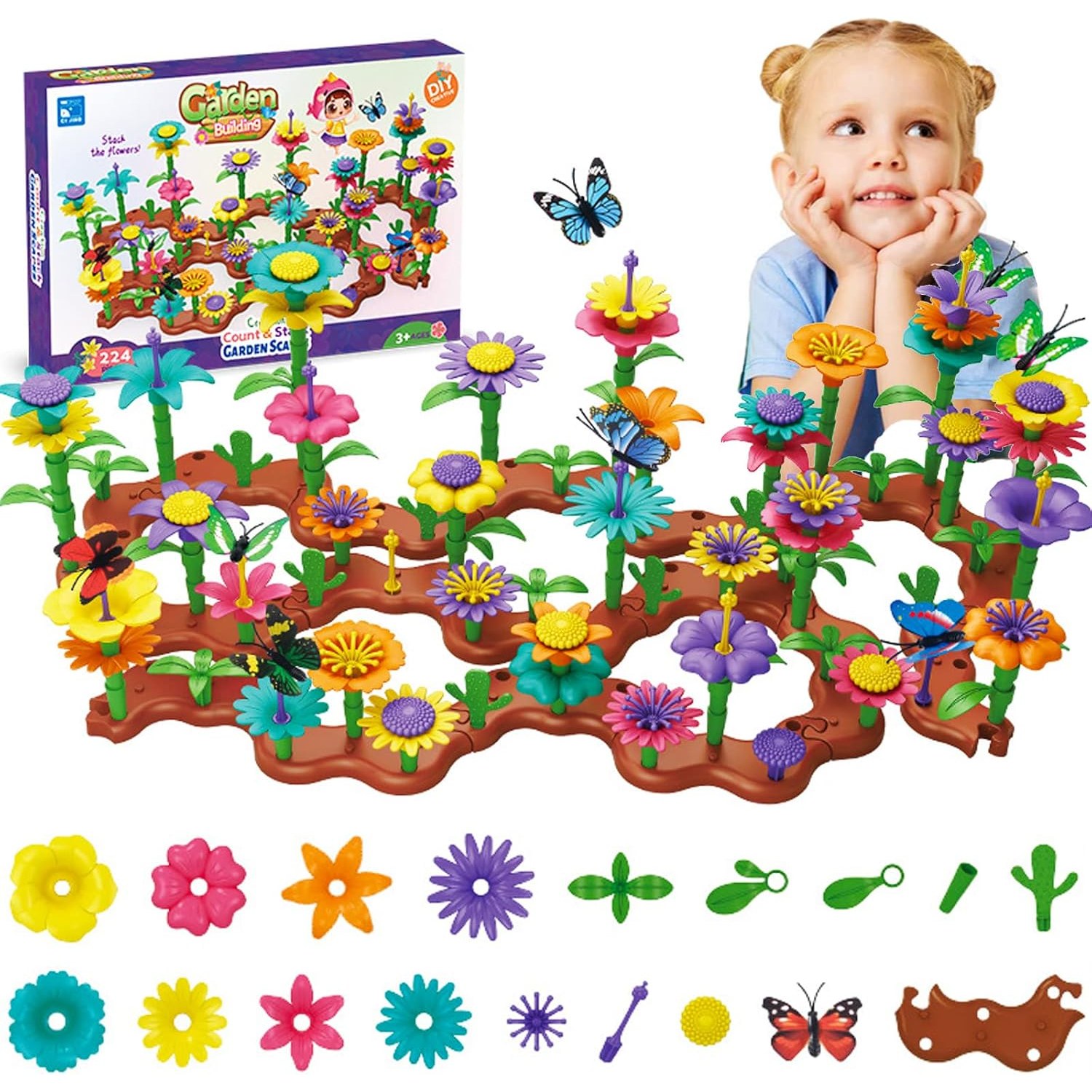
224-Piece Flower Garden Building Set

$45.99 $54.99 Save $9
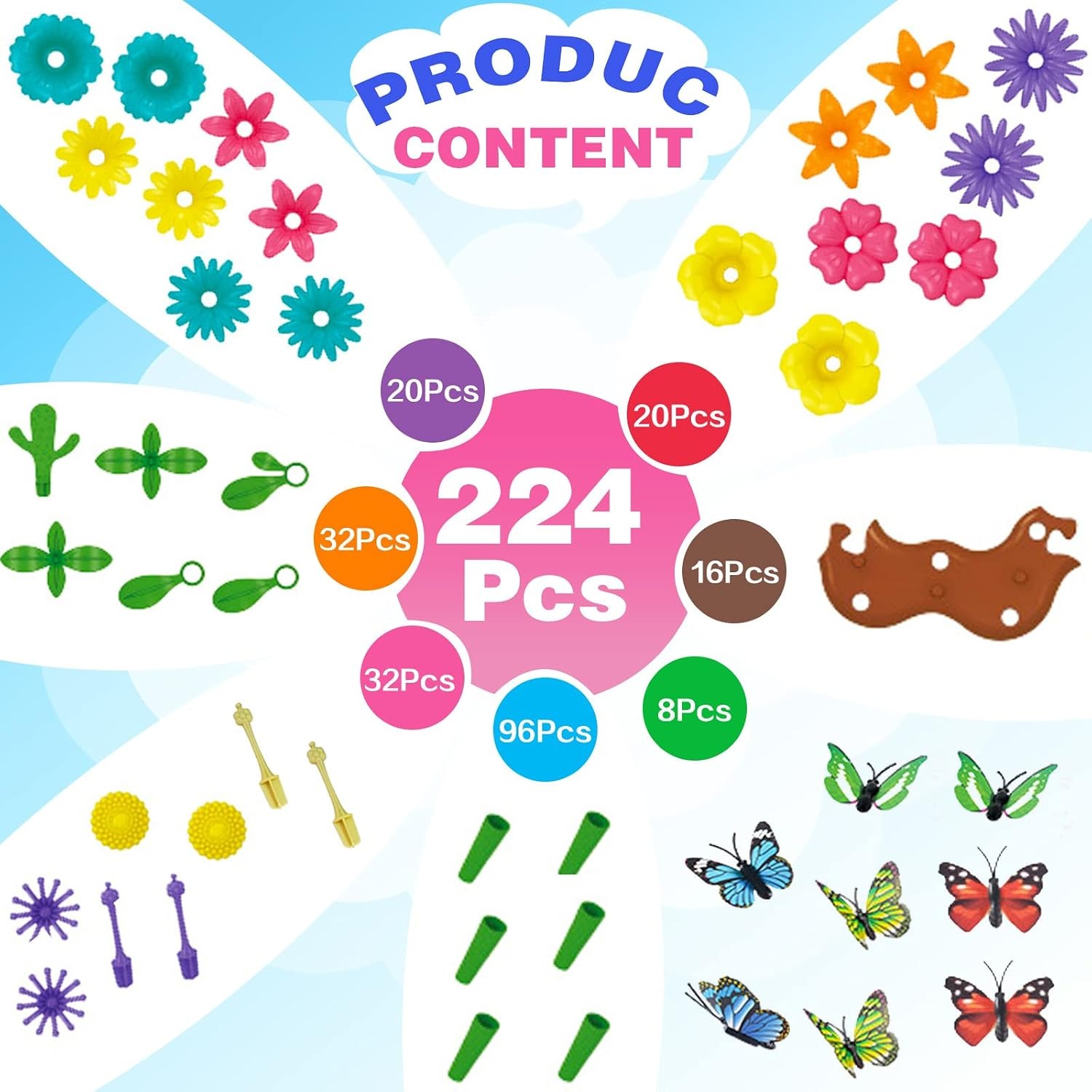
  • 224 Pieces
  • Five Bright Colours
  • STEM Play Value
  • Ages 3 and Up

Price: $45.99 $54.99

  • Free tracked Australia-wide delivery on orders $150+, otherwise a flat $15
  • Pay by card or PayPal, handled by the payment provider
  • 14 days to change your mind, plus your statutory rights
Product specifications
Set NameFlower Garden Building Toys
BrandYI XING LONG
Sub BrandGarden Toys
ManufacturerYI XING LONG
Model Year2023
Number of Pieces224
Unit Count224 Count
ColoursYellow, pink, purple, orange, blue
ThemeFloral
MaterialPlastic
Block TypeInterlocking toy building block
Assembly RequiredYes
Operation ModeManual
Number of Players1 to 6
Manufacturer Recommended Age3 years and up
Target AudienceKids aged 3 to 8 years old
Age Range DescriptionKid
Educational ObjectiveVisual development, hand-eye coordination, creative thinking, patience skills, STEM
Additional FeaturesNon toxic
Item Dimensions35 x 24 x 6 cm
Shipping & returns

Tracked delivery anywhere in Australia. It is free on orders of $150 or more, and a flat $15 below that.

If it is not right for you, send it back within 14 days of delivery in resaleable condition and we refund the price you paid, including standard delivery. That is a voluntary policy we offer on top of your legal rights. You cover the cost of returning it unless the item is faulty.

If it arrives faulty, damaged or not as described, we put it right at no cost to you under the Australian Consumer Law and the Competition and Consumer Act 2010, return postage included.

Shipping details · Refunds and returns

224 PiecesEnough petals, stems and bases for several bouquets at once.
Five Bright ColoursYellow, pink, purple, orange and blue for easy colour sorting and mixing.
STEM Play ValueBuilds hand-eye coordination, creative thinking and patience.
Ages 3 and UpRecommended by the manufacturer for children from three years old.

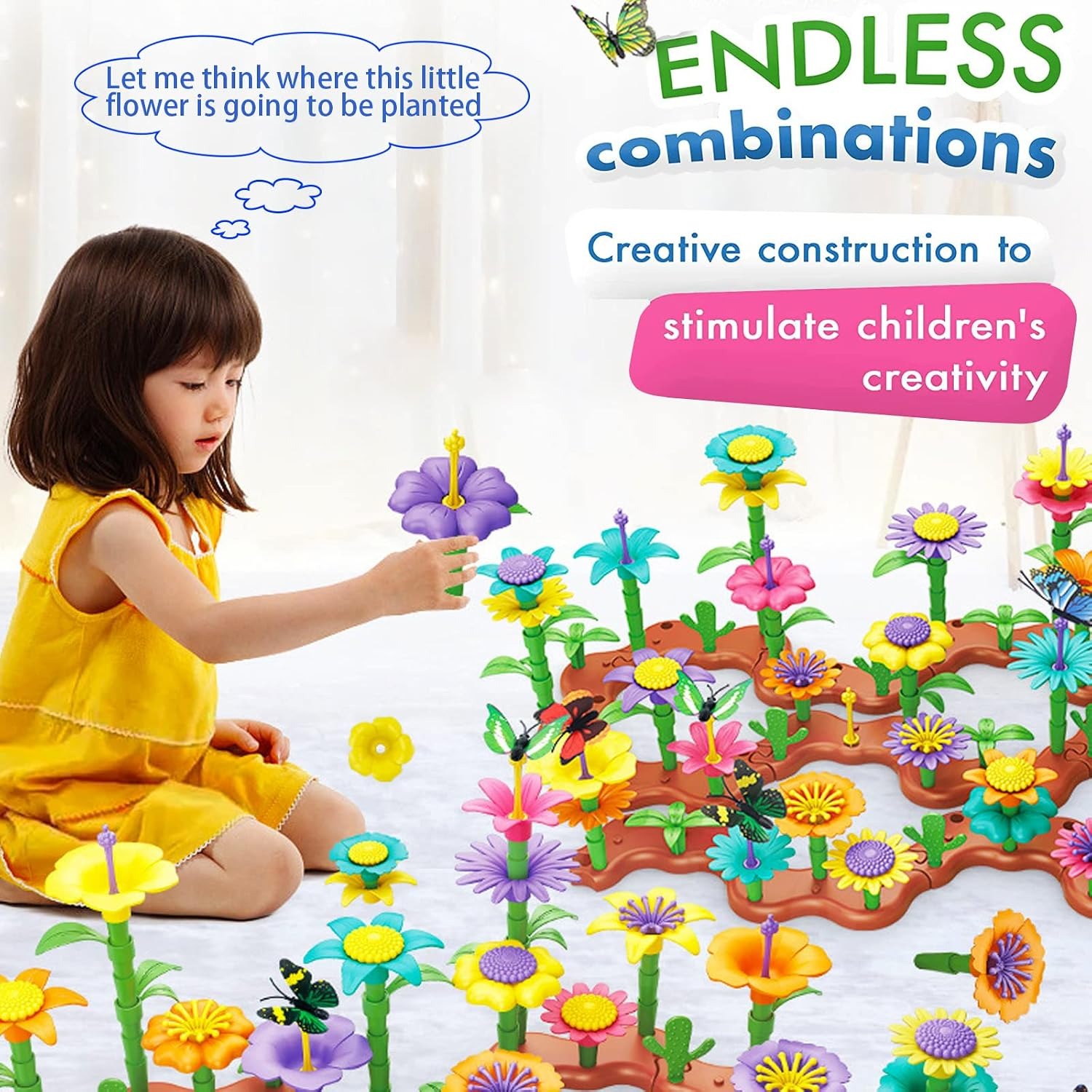
Hand your child a flower garden building set and watch a bare tabletop turn into a bouquet nobody has ever built before.

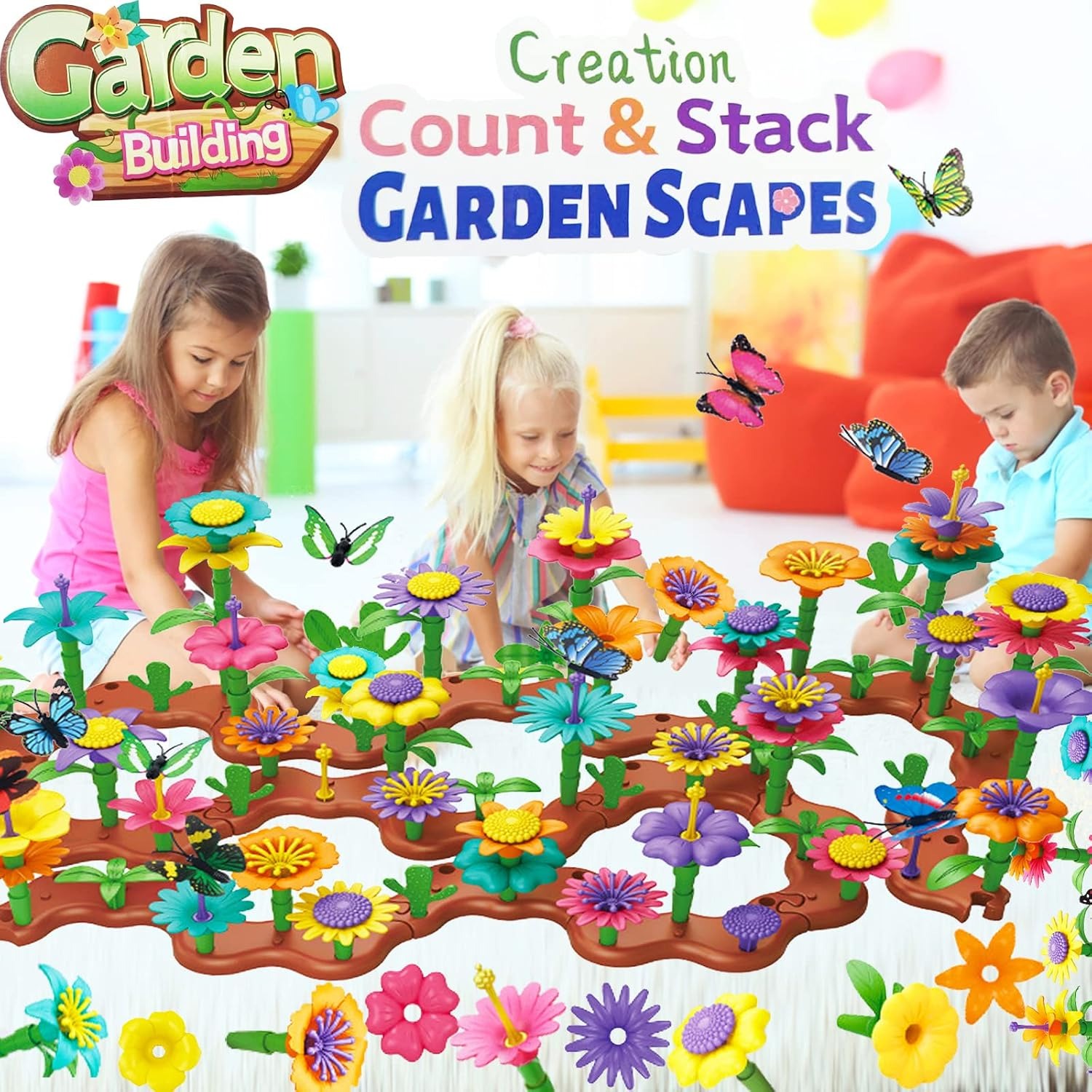
With 224 interlocking petals, stems and butterflies in five colours, this garden construction toy builds fine motor skills, colour recognition and patience while kids think they are just playing.

A 224-piece flower garden building set that lets children design bouquets, stems and garden scenes from scratch.

Bent and forked stalk pieces mean no two flowers have to look the same, so the play stays fresh week after week.

Five colours (yellow, pink, purple, orange and blue) make sorting, patterning and colour naming part of the game.

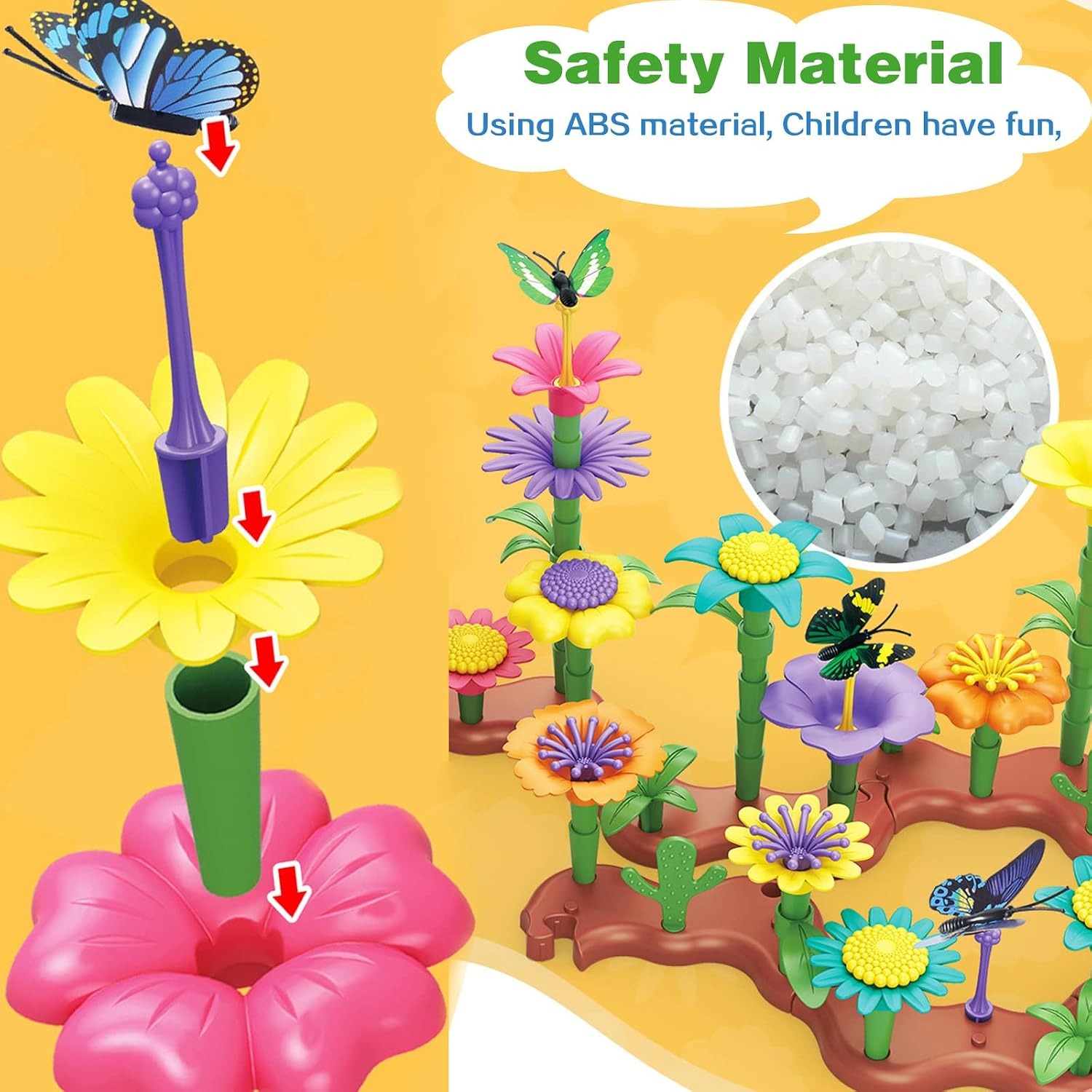
The interlocking plastic pieces push together and pull apart by hand, so small fingers can build without adult help.

Packed flat in a 35 x 24 x 6 cm box, it travels easily to grandparents, holidays or a classroom shelf.

224-Piece Flower Garden Building Set

Most building sets ask a child to copy a picture. This one does not. The 224 pieces in this flower garden building set are petals, stalks, bases and butterflies, and they fit together in whatever order a child decides. A tall purple stem with an orange bloom on top is just as correct as a short squat one with four petals stacked like a layer cake. That open ending is the whole point, and it is why the set tends to hold attention longer than a kit with one fixed outcome.

224-Piece Flower Garden Building Set

The stalk pieces are the clever part. Some are straight, some are bent, and some fork into two or three branches. A child who wants a drooping flower bends the stem that way. A child who wants a bush uses the forks and keeps adding. Because every piece connects by hand with a simple push, there are no tools, no glue and no instruction booklet to lose. Pulling pieces apart is just as easy, which matters a lot when a four year old changes their mind halfway through.

224-Piece Flower Garden Building Set

Colour does a quiet job here too. With yellow, pink, purple, orange and blue in the box, you can turn the set into a sorting game, a pattern game or a straight colour-naming session for a younger child. Older children start doing it on their own, building a bouquet that only uses warm colours, or alternating petals in a repeating sequence. That is early maths dressed up as a flower, and it does not feel like a lesson.

224-Piece Flower Garden Building Set

The manufacturer recommends the set for children aged three and up, with a target audience of three to eight years. In practice the younger end of that range builds single flowers and simple towers, while six and seven year olds start laying out whole gardens across a table, naming each plant and deciding where the butterflies land. Up to six children can play at once according to the listed specs, so it works for siblings, a play date or a small group activity at a childcare centre or classroom.

224-Piece Flower Garden Building Set

Everything packs back into a box measuring 35 x 24 x 6 cm, which is slim enough for a bookshelf and light enough to carry. The pieces are plastic and listed as non toxic, so a wipe with a damp cloth is all they need after a busy afternoon. If you are hunting for a screen free toy for kids that survives repeated use and does not need batteries, this is a sensible place to start.

Not sure yet? That is fine.

A toy has to suit the child it is for, and you cannot always judge that from a photograph. If it is not right for you, send it back within 14 days of delivery in resaleable condition and we refund the price you paid, including standard delivery. That is on top of your Australian Consumer Law rights if anything arrives faulty.

If it turns up faulty, damaged or not as described, that is on us. The Australian Consumer Law and the Competition and Consumer Act 2010 covers you, and we pay the return postage. Read the full detail on our refunds and returns page, or ask us anything before you order.

Frequently Asked Questions

What exactly is in the box?

The set contains 224 pieces in total, made up of petals, stems, bases and butterfly pieces. The colours are yellow, pink, purple, orange and blue. The exact count of each individual piece type is not specified by the maker.

What age is this flower garden building set for?

The manufacturer recommends it for ages 3 years and up, with a listed target audience of children aged 3 to 8. Younger builders usually make single flowers, while older ones design whole gardens. Adult supervision is sensible with any set that has small parts.

Is it suitable for a 3 year old?

Yes, three is the manufacturer's recommended minimum age. At that age most children build one flower at a time and enjoy pushing pieces together more than planning a design. It is one of the better building toys for 4 year olds as well, because the pieces stay interesting as skills grow.

Do boys enjoy this set too?

Plenty do. The theme is floral, but the activity is construction, sorting and problem solving, which has no gender. If a child likes stacking, clicking pieces together or making things stand up tall, this will land well.

How do the pieces connect?

They are interlocking building blocks that push together by hand. No clips, tools or glue are needed. Pulling them apart takes a gentle tug, so children can rebuild as often as they like.

Is assembly required?

Yes, assembly is part of the play. The product details list assembly as required and the operation mode as manual. There is nothing to put together before a child can start.

Does it need batteries?

No. The operation mode is manual, so there are no batteries, no charging and no electronics. It works just as well on a camping trip as it does at the kitchen table.

What is it made of?

The material type is listed as plastic, and the set is described as non toxic. The specific plastic grade is not stated by the maker.

How big is the box?

The item dimensions are 35 x 24 x 6 centimetres. That is slim enough to slide onto a bookshelf or pack into a suitcase for travel.

How heavy is it?

The product weight is not specified by the maker. Based on the piece count and plastic construction it is light enough for a child to carry the box short distances.

How many children can play at once?

The listed number of players is 1 to 6. With 224 pieces there is enough material for a few children to work on separate bouquets, or for the whole group to build one large garden together.

What skills does it help develop?

The stated educational objectives are visual development, hand-eye coordination, creative thinking, patience skills and STEM. In practice that means fingers get stronger, colours get named and children learn to plan a build before they start. It is a solid pick as a fine motor skills toy.

Is this a STEM toy?

STEM is listed among its educational objectives. Children experiment with balance, structure and symmetry while they build, and they learn by trial when a tall stem topples. It is a gentle introduction rather than a formal science kit.

Can the pieces be mixed with other building block brands?

The set is designed to work with its own pieces, and compatibility with other brands is not stated by the maker. We would not count on them clicking into standard studded bricks. Children often combine them loosely in play anyway.

Is it a good gift?

It arrives as a boxed set, which makes it easy to wrap and give. It suits birthdays, Christmas, Easter and end-of-year gifts, and the open-ended play means it does not get solved and abandoned in a week. Many shoppers rate it among the best birthday gift options for a 3 year old.

Will it keep a child busy for long?

Open-ended sets usually hold attention longer than kits with one right answer. Children tend to build, knock down and rebuild in sessions of twenty minutes to an hour. It also works well as a quiet time activity before bed.

Can it be used in a classroom or childcare setting?

Yes. With up to six players and a clear link to colour recognition, counting and fine motor work, it fits well on an early learning shelf. Teachers often use sets like this for free play stations or small group tasks.

Is it suitable for a child under 3?

The manufacturer recommends 3 years and up, so it is not intended for children under three. Small parts can be a choking hazard for younger children. Keep the set out of reach of children under 3.

How do I clean the pieces?

Wipe them with a damp cloth and a drop of mild soap, then dry fully. Avoid dishwashers, microwaves and hot water, which can warp plastic. A quick wipe after a sticky-handed session is usually all that is needed.

How should I store the set?

Keep the pieces in the original box or a clear lidded tub so none go missing. Sorting by colour into small containers also turns tidy-up into part of the game. Store away from direct sunlight and heaters.

What if some pieces get lost?

With 224 pieces, losing a few will not stop the play. Because builds are free-form rather than instruction based, a missing petal has no effect on what a child can make.

Can it be played with outdoors?

Yes, the pieces are plastic and light, so a picnic rug, a park table or a back deck all work. Just be mindful on grass or sand where small pieces disappear easily. A tray or shallow box helps keep everything contained.

Does it come with instructions?

There is no fixed model to copy, so there is nothing to follow step by step. Children invent their own flowers. If you want a starting point, build one simple flower yourself and let them take it from there.

Is this good for parent and child play?

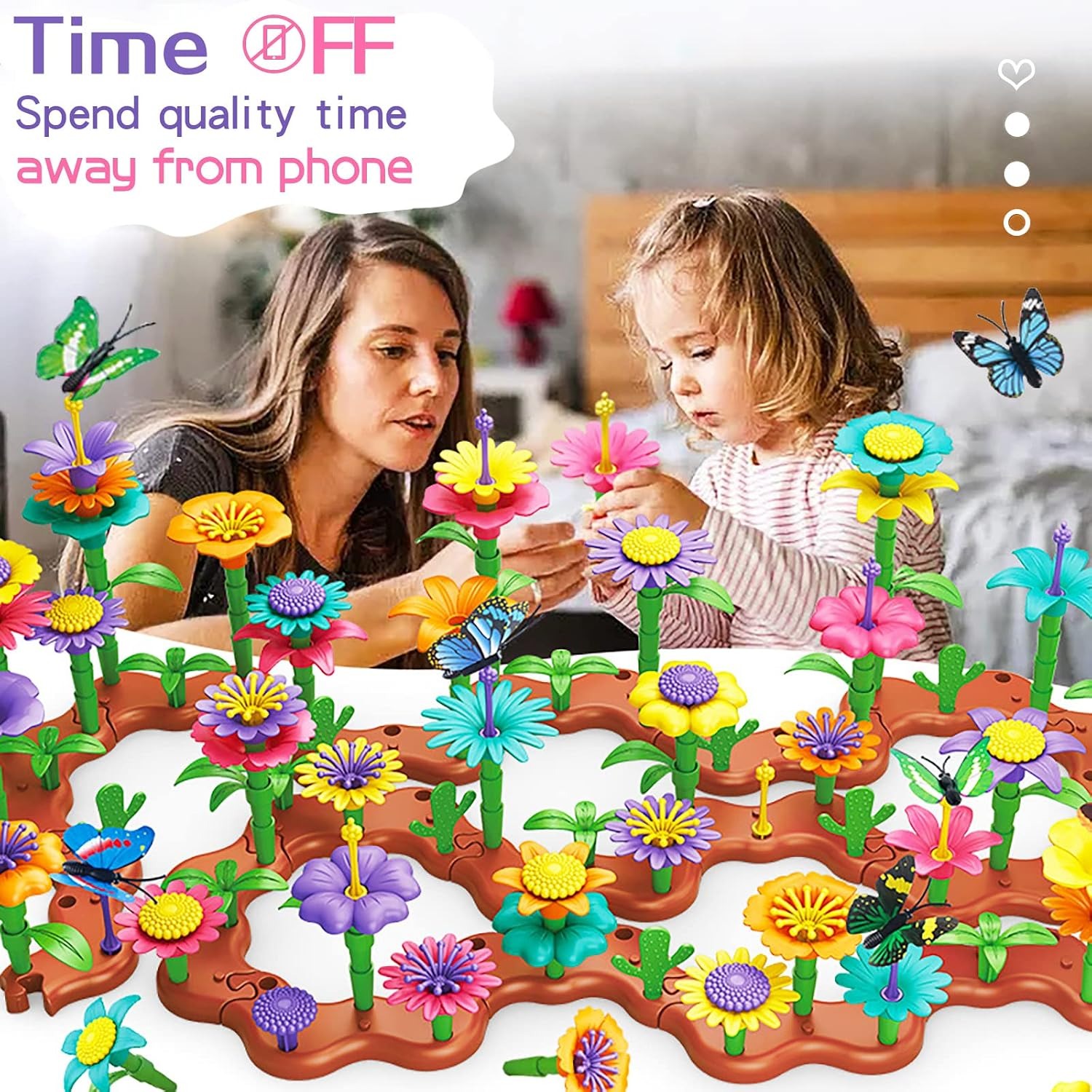
It is one of the better parent and child building games because there is no pressure to be right. Sit down, build your own flower alongside theirs, and swap pieces. Conversation follows naturally.

Does it help with colour learning?

With five distinct colours, yes. You can sort pieces into colour piles, ask a child to build a flower in one colour only, or make repeating patterns. That is useful groundwork for early maths.

Is the plastic safe to handle?

The product details list it as non toxic. As with any toy, wash hands after long play sessions and keep pieces out of mouths. Supervise younger children at all times.

Can older children still enjoy it?

The listed target audience runs to eight years. Older children often shift from building single flowers to designing a full garden layout, or setting challenges like the tallest stem that still stands. Beyond eight, interest usually depends on the child.

How is the set delivered?

It ships in its retail box, packed for transit. Delivery times depend on your location and are shown at checkout. You will receive tracking details once the order is dispatched.

Can I return it if it is not what I expected?

Yes. If the set is not right for your child, contact us with your order number and we will walk you through the return process. Keeping the original box makes the return simpler.

What if a piece arrives damaged or the set is incomplete?

Get in touch with a photo and your order number and we will sort it out. Manufacturing faults and transit damage are covered by our returns process. We would rather fix it than have a child open a disappointing box.

The Honest Buyer's Guide to Flower Garden Building Sets

6 min read Toy Warehouse

The toy that gets played with twice

Every parent knows the pattern. A box arrives, it gets built once according to the picture on the front, and then it sits on a shelf as a finished object nobody is allowed to touch. The build was the whole experience, and the experience lasted forty minutes.

Open-ended sets work differently. There is no picture to match, so there is no moment where the toy is finished. A flower garden building set gives a child 224 petals, stems, bases and butterflies and nothing else. No model number, no step twelve, no right answer. The first flower a three year old makes is a lopsided stack of two petals on a short stalk, and that counts. So does the sprawling six-stem bush a seven year old builds a year later.

That difference matters more than almost any other feature when you are choosing a toy that has to last.

How it actually works

The pieces are interlocking plastic blocks. They push together by hand and pull apart the same way, with no tools, no glue and no batteries. The operation mode is listed as manual, which is a dry way of saying a child's hands are the only power source.

The stems are where the design earns its keep. Alongside straight stalks there are bent pieces and forked pieces that split into branches. A straight stalk gives you a tulip shape. A bent one gives you something drooping and a bit sad, which children find hilarious. A forked one lets a single base support three separate blooms, and once a child works that out, the builds get noticeably more ambitious.

Petals stack. Butterflies perch. Bases hold the whole thing upright on a table. The physics is simple enough for a preschooler to grasp by feel, but there is still a real lesson in it. Build a stem too tall with too many petals on top and it tips over. Nobody has to explain why. The flower just falls, and next time the child builds a wider base.

That is the quiet value of a good garden construction toy. The feedback is instant and it comes from the toy, not from an adult correcting anyone.

Who this suits

The manufacturer recommends ages 3 and up, with a target audience of three to eight years. Those are useful brackets, but the way play changes across them is worth knowing before you buy.

At three and four, expect single flowers. The appeal is tactile: the click of pieces joining, the satisfaction of a thing standing up. Builds are short and get dismantled fast. This is exactly the age where a set like this does the most for fine motor strength, because pressing two pieces together takes real grip.

At five and six, planning appears. A child will decide they are making a garden, then sort pieces by colour before they start. They will give flowers names. They will get annoyed when a stem falls and will try again with a different approach. This is the sweet spot for creative toys for 5 year olds, where the child's ideas have outgrown their hands just slightly and the gap is motivating rather than frustrating.

At seven and eight, it becomes a design exercise. Tallest tower, symmetrical bouquet, a garden laid out in colour blocks. Some children at this age also start using the pieces as props in longer stories, which is a different kind of play entirely but just as valuable.

The listed number of players runs from one to six, so it works solo and in groups. For a play date or a classroom free-play station, 224 pieces spread across a few children is enough to avoid squabbling, as long as you dump them in the middle rather than divide them up.

Choosing between building sets

If you are weighing this against other options, a few questions sort things quickly.

Does it have one correct outcome? Instruction-based kits teach sequencing and following directions, which are genuinely useful. But they get completed. If you want something that keeps returning to the table, pick open-ended.

How small are the pieces? Anything with very small components is a choking risk for under-threes and a vacuum cleaner risk for everyone. This set is rated 3 and up and should be kept away from children under 3 in the house.

Does it need batteries or charging? Toys that light up and make noise get strong first reactions and fade fast. Manual sets have a flatter curve but a much longer tail.

Can it travel? The box here measures 35 x 24 x 6 cm, slim enough for a shelf or a suitcase. A toy that can come to grandparents' house or on a holiday gets used far more than one that only works in one room.

Is it washable? Plastic that wipes clean survives the realities of children. Fabric and cardboard do not.

Getting the most out of it

A few things help in the first week.

Start by building one flower yourself and leaving it on the table without saying anything. Most children will pick up pieces and start copying, then diverge within minutes. Handing over a box and an instruction to "be creative" works far less well than quietly modelling it.

Try colour challenges once the novelty settles. Build a flower using only blue and purple. Make a pattern that goes yellow, pink, yellow, pink up a stem. Sort the whole set by colour before packing up. These sound like chores but children treat them as games, and they fold colour recognition and early patterning into the play without anyone mentioning learning.

Set up a tray. A shallow baking tray or a large lid keeps pieces from migrating under the sofa and gives the build a defined edge, which young children find oddly reassuring.

Build alongside them rather than for them. The temptation to fix a wobbling flower is strong. Resist it where you can. Letting a build fall and watching a child solve it is the entire point of a toy like this.

Care and keeping it together

Plastic is forgiving, which is most of why it is used for sets like this. Wipe the pieces with a damp cloth and a little mild soap when they need it, then dry them properly before they go back in the box. Skip the dishwasher, the microwave and hot water, all of which can warp plastic and loosen the fit between pieces.

Storage is the real battle. The original box works fine. A clear lidded tub works better, because children can see what is inside and are more likely to ask for it. Sorting into small colour-coded containers is extra effort for you but turns tidy-up into a sorting activity, which is a reasonable trade.

Keep the set away from heaters and out of direct sunlight on a windowsill. Prolonged heat is the main thing that shortens the life of plastic toys.

If pieces go missing over time, it genuinely does not matter. There is no model to complete, so a lost petal costs you nothing. That is another advantage of free-form sets over kits where one absent part ruins the whole thing.

The short version

This is 224 interlocking plastic pieces in five colours, rated for ages 3 and up, that let a child build flowers and gardens however they want. There is no instruction booklet, no batteries and no fixed result. The listed benefits are visual development, hand-eye coordination, creative thinking, patience and STEM, and all of those happen through ordinary play rather than anything that feels like a lesson.

It suits a wide age band, handles up to six players, packs flat into a 35 x 24 x 6 cm box and wipes clean. If you want a screen free toy for kids that gets pulled off the shelf more than once, and you are happy with a floral theme, this is a straightforward choice.

If your child is under three, wait. If they already own several open-ended building sets and never touch them, this will probably join the pile. For everyone else, it does the job.

Browse the shop

Not sure if it suits your child?

Send us their age and what they usually play with, and we will tell you straight whether this set is a good match.

Ask us a question

Page summary

The 224-Piece Flower Garden Building Set by YI XING LONG is an interlocking plastic construction toy for children aged 3 and up, with a listed target audience of 3 to 8 years. The set contains 224 pieces in yellow, pink, purple, orange and blue, including petals, straight, bent and forked stalks, bases and butterflies, allowing children to build bouquets and garden scenes freely. Assembly is manual and required, with no tools or batteries. Listed educational objectives are visual development, hand-eye coordination, creative thinking, patience skills and STEM. The set supports 1 to 6 players, is described as non toxic, and ships in a box measuring 35 x 24 x 6 cm. Model year 2023. Product weight, country of origin and GTIN are not specified by the maker.