
The complete guide
Friction Monster Trucks Buyer's Guide, How Push And Go Toys Work And Who They Suit
The battery problem nobody warns you about
There is a particular kind of disappointment that happens about forty minutes into a birthday party. A new toy car stops working. Somebody goes hunting through the kitchen drawer for AA batteries, finds three dead ones and a 9V, and the child stands there holding a silent piece of plastic. Meanwhile a plain wooden car with no electronics at all is being pushed happily around the skirting board.
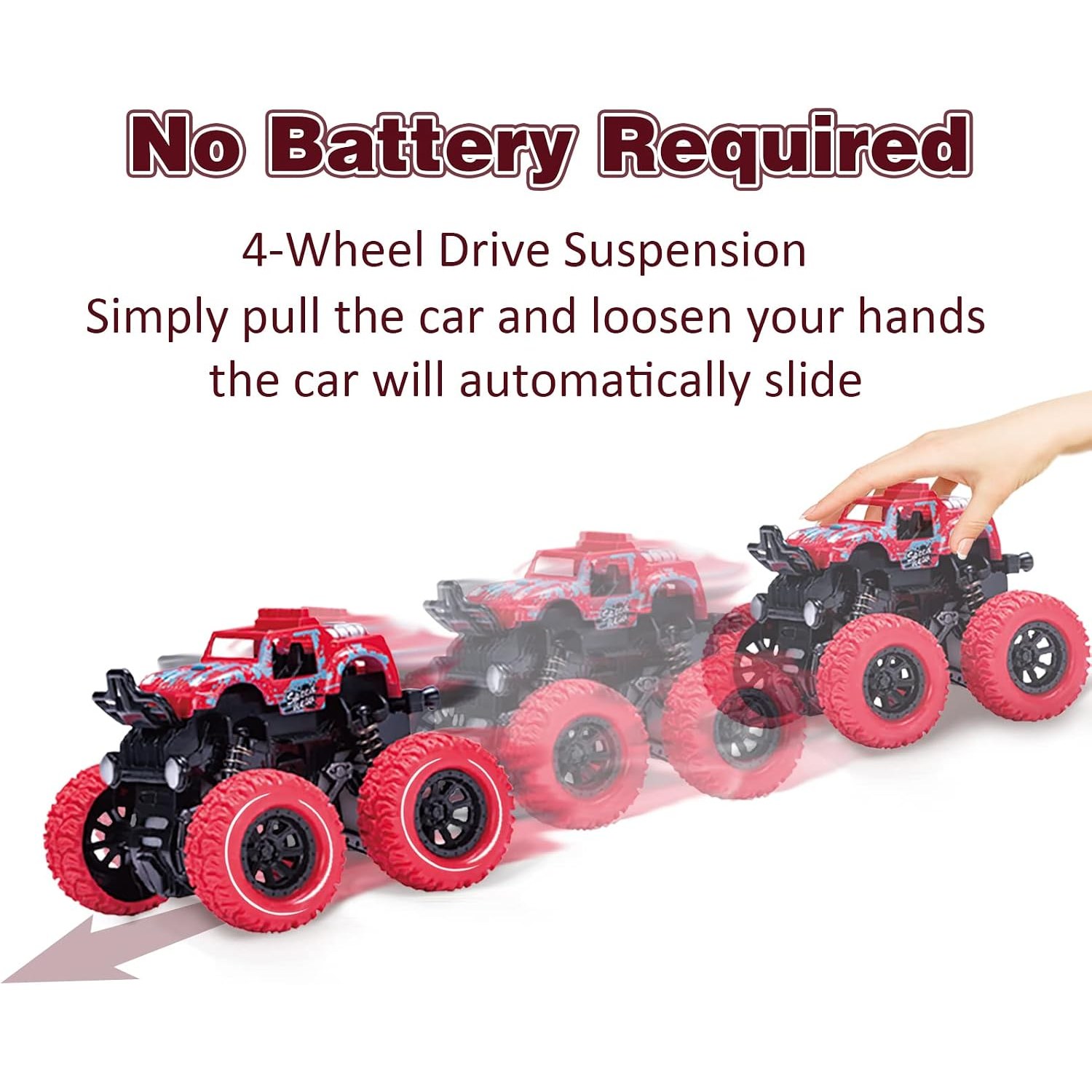
Friction toys sit in the sweet spot between those two extremes. They do something, they move on their own, they feel a bit magic to a four year old, and they never need charging. That is the whole appeal of this pack of four monster trucks. You push, you let go, the truck keeps going. No switches, no charging cables, no surprise flat battery on Christmas morning.
For a lot of parents, that reliability is the deciding factor. The best push and go cars for preschoolers are the ones that still work on the hundredth day, not just the first.
How friction drive actually works
Inside each truck is a small weighted flywheel connected to the rear wheels through a gear. When a child pushes the truck forward along the ground, the wheels turn, the gear spins the flywheel, and the flywheel picks up speed. Keep pushing and you keep adding energy.
Then you let go. The flywheel is still spinning fast, and because it is linked to the wheels, it keeps driving them. The truck rolls on under its own steam until friction and air resistance slow the flywheel down.
That is the entire mechanism. No electronics, no motor, nothing that can go flat. It also explains the two things children learn fastest with these toys. First, a longer push means a longer run. Second, the surface matters enormously. A truck that crosses a whole tiled kitchen might only manage a metre on thick carpet. Kids work this out through trial and error, and they adjust without anyone telling them to.
Why four trucks beats one
A single toy car is a lovely thing until a second child walks into the room. Then it becomes a negotiation.
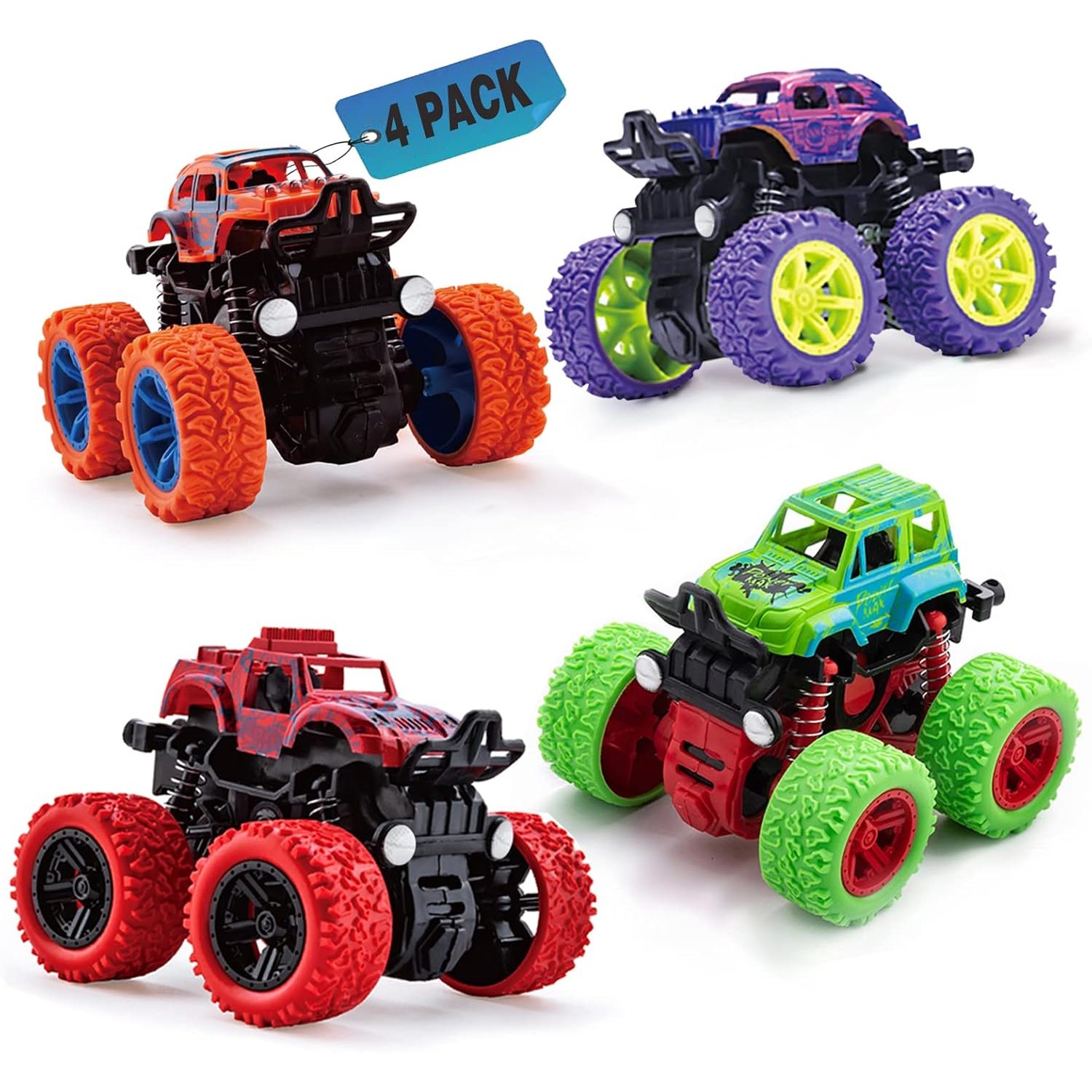
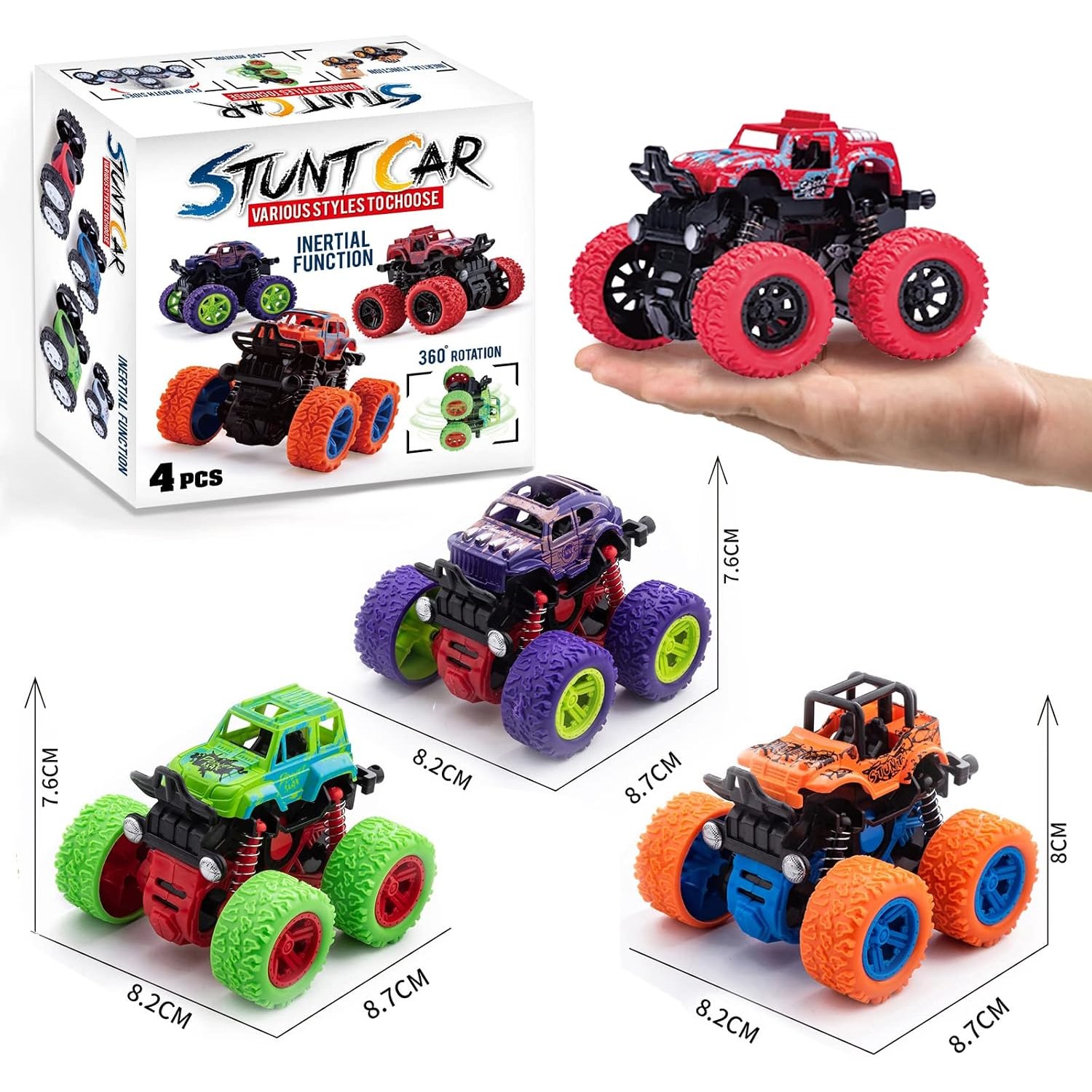
This set contains four trucks in red, purple, green and orange. In practice that means a few useful things. Siblings can each claim a colour, which heads off most of the ownership arguments before they start. One child alone can set up a grid and race the trucks against each other, which turns a two minute toy into a twenty minute game. And when a friend visits, there is a spare without anyone having to give up their favourite.
Four also makes the pack work as more than one gift. Plenty of people buy a single box and split it between two kids, or peel off a truck or two for party bags. For class gifts and goody bags, it is hard to beat the maths on a four pack.
Built for actual play, not display
Toy cars get thrown. They get stepped on, dropped down stairs, driven into door frames at full speed and occasionally sat on. A toy that only survives careful handling is not really a children's toy.
These trucks are moulded from ABS plastic, which is the hard, impact-resistant plastic used in a lot of hard-wearing kids gear. It flexes rather than shattering when it takes a knock. That is the baseline requirement for anything that is going to live on a living room floor.
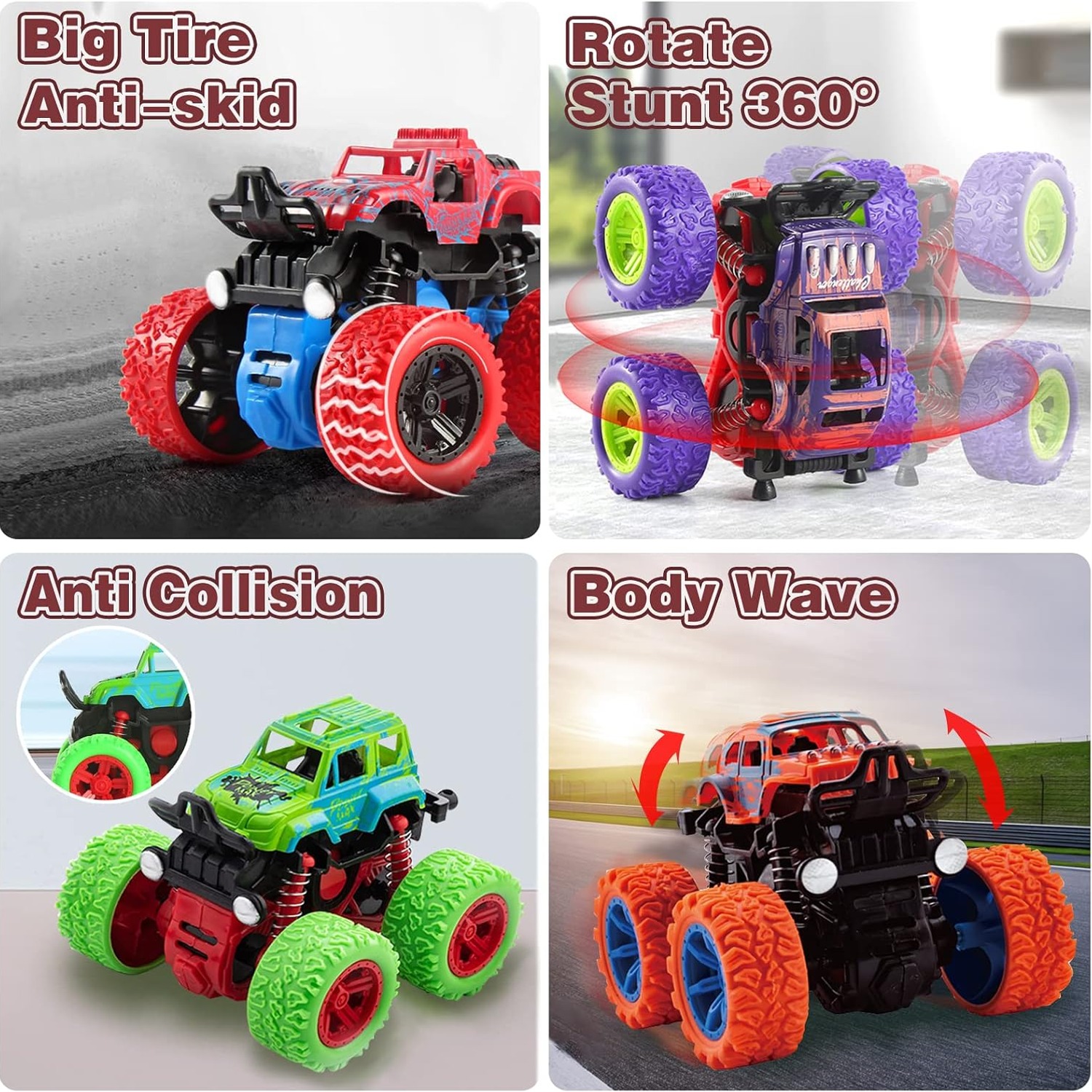
On top of that, each truck has four springs sitting between the body and the wheel assembly. When a truck lands after a jump off a book ramp or clips a kerb outdoors, some of that impact goes into the springs instead of straight into the shell. You can see them compress if you press down on the body.
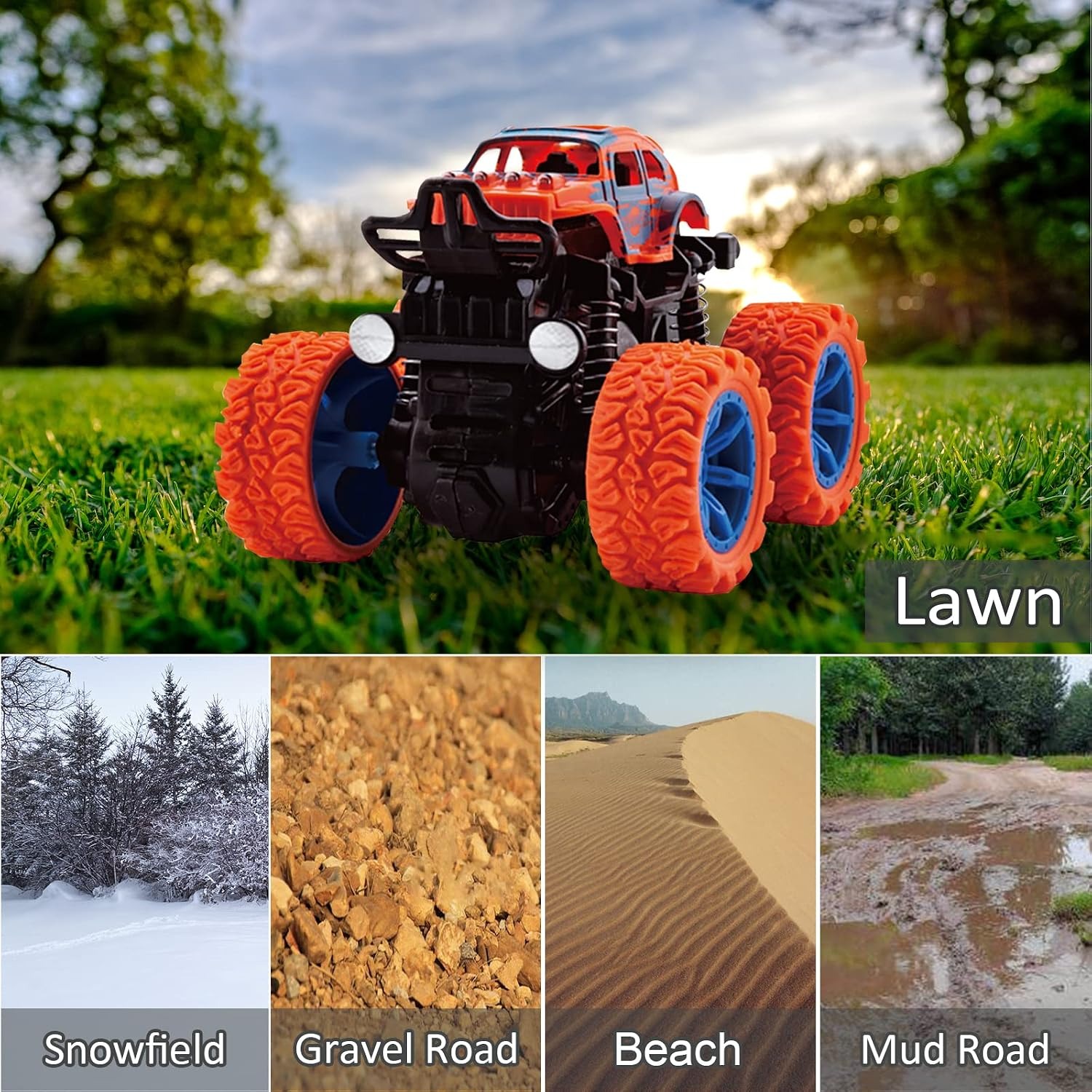
The oversized wheels are the third piece. Small smooth wheels stop dead at a rug edge or a gap in the paving. Big wheels with deep tread roll straight over door thresholds, gravel, cracks and short grass. If you have ever watched a cheap toy car get stuck on a transition strip between two rooms, you will understand why this matters.
Where they work best
Hard flooring is the happy place. Tiles, sealed timber, lino and vinyl all let the trucks run their full distance, and the sound of wheels on hard floor is half the fun for a small child.
Low-pile carpet and rugs work fine, just with a shorter run. Deep shag carpet is the one surface that really defeats them, as the pile swallows the wheels.
Outdoors is where friction cars come into their own. A sloping driveway is basically a free racetrack. Concrete paths, patios and short dry grass all work. The trucks are described as weather resistant, so a bit of damp on the way home is not a disaster, though you should still wipe them down and dry them off. Sand is the one to avoid, because dry sand gets into the axles and the mechanism does not like it.
Who these suit
The recommended age is 3 years and up, and the way children play with them changes a lot across that range.
At three, the appeal is pure cause and effect. Push, release, watch it go. There is no instruction manual to understand and nothing to break the flow. These are among the best toy trucks for 3 year olds precisely because the rules are so simple.
Around five or six, the games get structured. Races with starting lines. Ramps built from books and cushions. Crashes staged deliberately, usually with sound effects. The four colours become teams.
By seven or eight, kids are testing limits. How far from the top of the driveway can they get? What happens if they push two at each other? This is the stage where the spring suspension earns its keep.
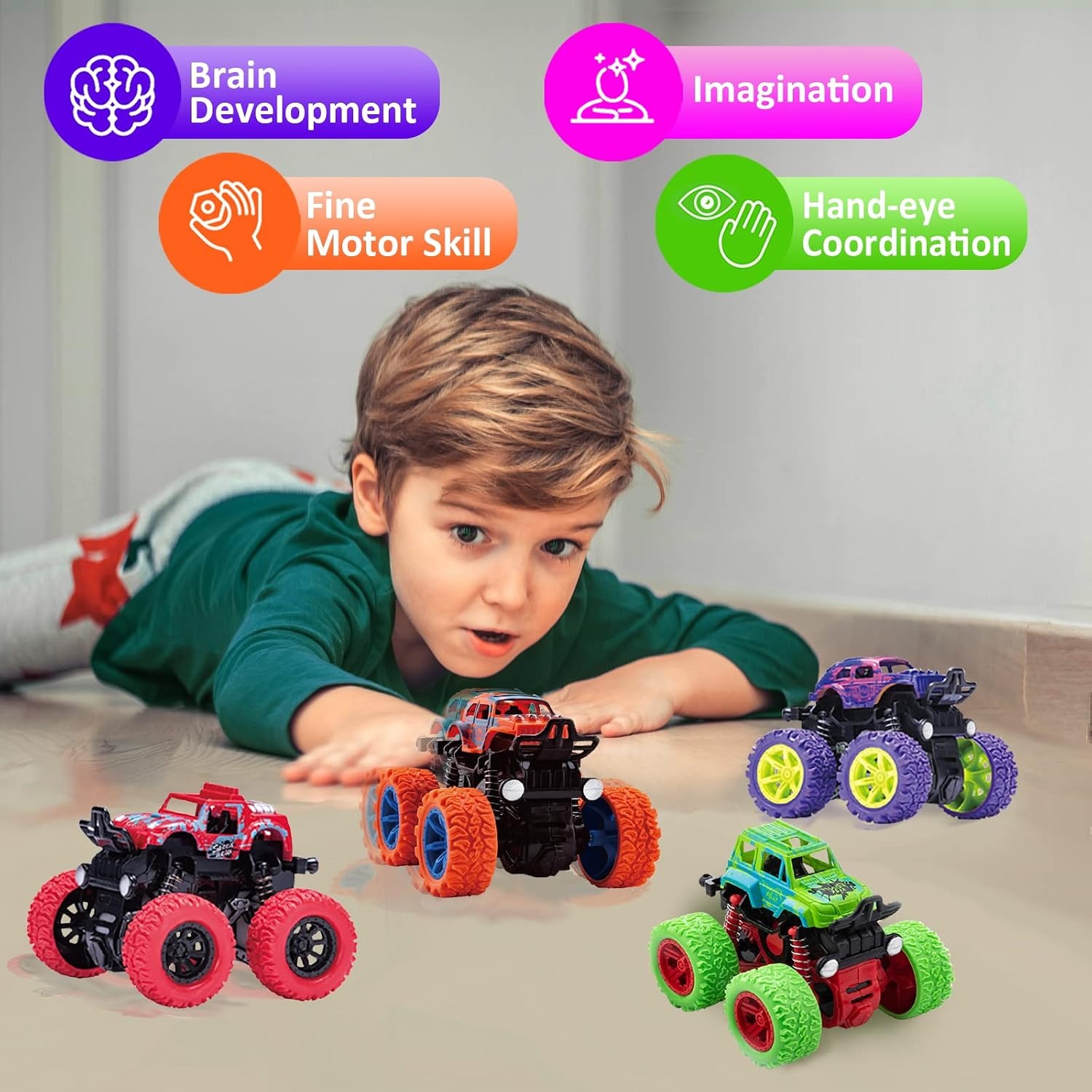
The stated learning aims are hand-eye coordination, observation and cooperation. That sounds more formal than it looks in practice. Aiming a truck at a target and judging the push is genuine motor practice. Sharing four trucks between three kids is genuine negotiation.
Looking after them
Maintenance is minimal but not zero. The single most common complaint about any friction toy is that it stopped rolling as far as it used to, and the cause is almost always the same. Hair, carpet fluff or grit has wound itself around an axle.
Turn the truck over every few weeks and have a look. Pull out anything wrapped around the axles, give the wheels a spin with your finger and check they turn freely. That takes thirty seconds and makes a real difference.
Wipe the bodies and wheels with a damp cloth after outdoor play, then dry them. Do not submerge them in water and do not put them in a dishwasher, because water sitting inside the friction mechanism is the fastest way to ruin it. Store them indoors rather than leaving them out in the weather all season.
Choosing between friction and pull back
People often mix these up, so it is worth being clear. A pull back car stores energy when you drag it backwards, then releases it when you let go, sending the car forward. A friction car stores energy when you push it forwards, and releases it in the same direction you pushed.
Friction tends to suit younger children slightly better, because the action matches the result. You push it forward, it goes forward. Pull back cars require a small mental flip that some three year olds find counterintuitive at first.
Friction toys also generally travel further on a good surface, which is more satisfying for outdoor and hallway racing.
The short version
If you want toy cars that work every single time, this set does the job. Four trucks, four colours, no batteries, no assembly, ABS plastic bodies, spring suspension and big wheels that handle real floors and real ground.
They suit children from three upwards, they travel well because nothing needs power, and having four of them turns a solo toy into a group game. Keep the axles clear of hair and grit, wipe them after outdoor play, and they should keep rolling for a long time.
For a gift that gets used rather than admired, a pack of friction monster trucks is a straightforward bet.