


The complete guide
Four In A Row, A Buyer's Guide For Families, Classrooms And Travel
The problem with most games you buy for kids
Think about the games currently sitting in your cupboard. Most of them fall into one of two groups. There are the ones with so many cards, tokens and rule exceptions that an adult has to run the whole thing, which means nobody plays them unless that adult is free and in a good mood. Then there are the ones so simple that they are pure luck, where a child can win without making a single decision and gets bored by the fourth round.
Four in a row sits in the narrow gap between those two. You can explain it in one sentence. There is nothing to set up, no cards to shuffle and no scoring system to remember. But every single turn is a decision, and the decisions get better the more you play. That is a rare combination, and it is why this game has stayed in family cupboards for decades while hundreds of flashier toys came and went.
The other problem it solves is the gap between ages. If you have a five year old and a ten year old, very few games work for both without one of them being patronised or frustrated. This one does, because the older child can handicap themselves invisibly by just not blocking, and the younger one never has to know.
How the game actually works
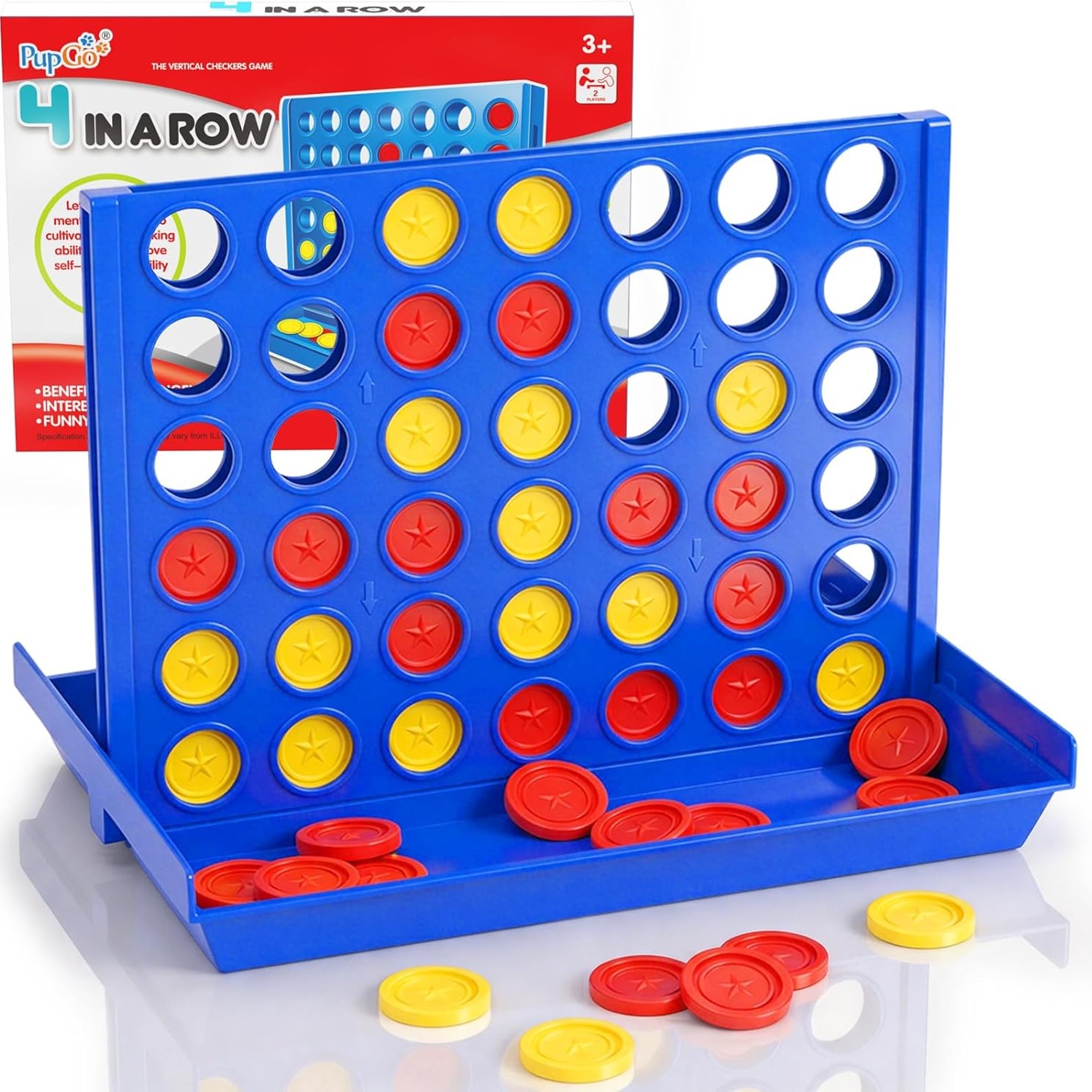
Two players each take a colour. You take turns dropping one disc into the top of a column on the upright grid. Gravity does the rest, and the disc settles on top of whatever is already in that column. The first player to form a straight line of four of their own colour wins, and the line can run across, up and down, or diagonally.
That diagonal is where the game gets interesting. Beginners watch the rows and columns and completely miss the slanting lines building up under their nose. Losing to a diagonal for the first time is a small rite of passage, and after that a player starts actually scanning the board instead of just stacking.
The standard set has 42 discs, 21 per player, which is exactly the number needed to fill the grid. If every disc goes in and nobody has made a line, the round is a draw. You clear it and go again, usually with the loser or the drawing second player starting next time to even things out.
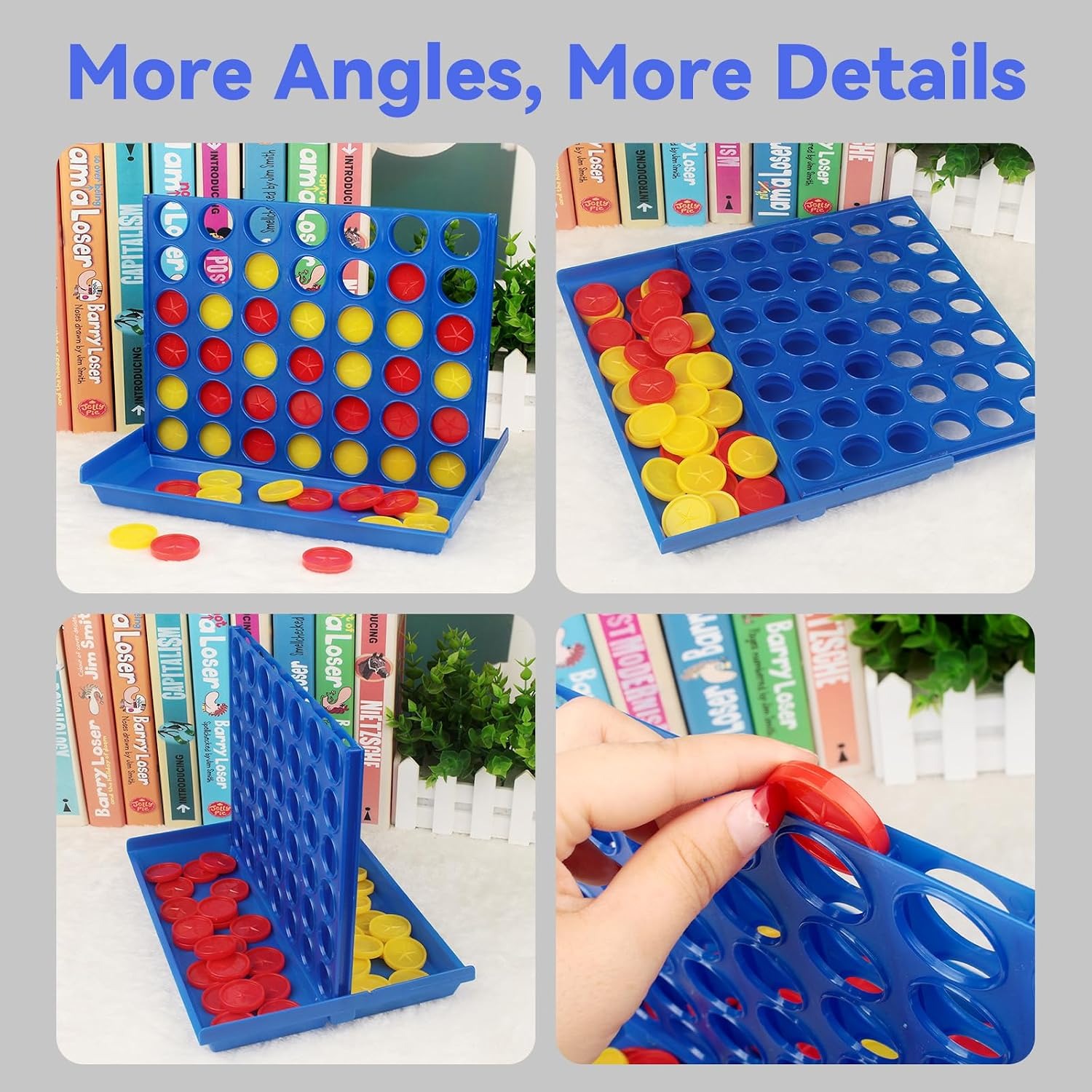
This set comes with those 42 counters plus 6 spares, so 48 pieces in total. The grid stands on its own tray, and when the round ends the discs drop into that tray instead of rolling off the table. If you have ever crawled around picking up game pieces at bedtime, you will understand why that detail is worth something.
Who it suits
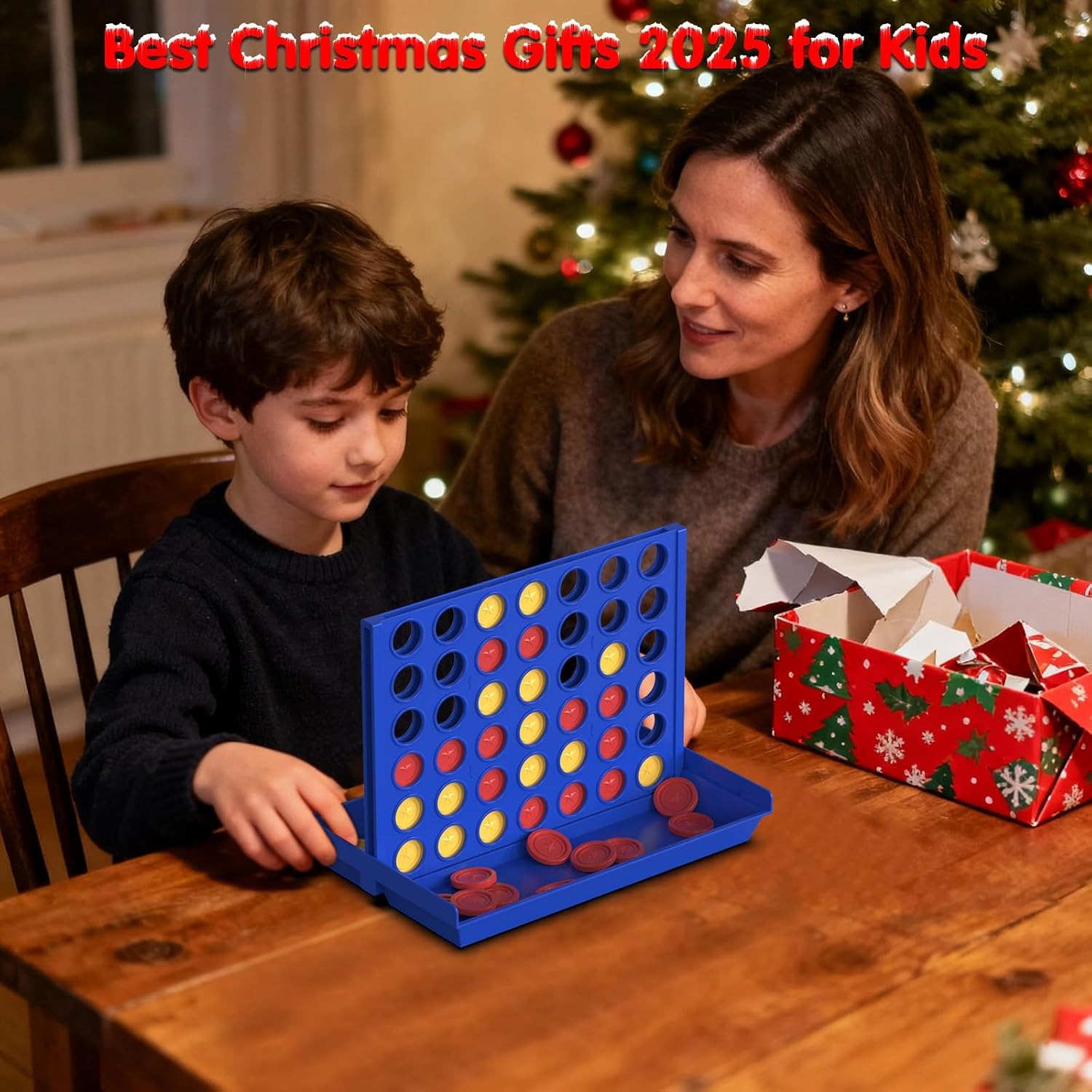
The recommended age is 3 and up. A three year old will mostly be enjoying the physical act of dropping discs and listening to them land, and that is fine, it builds the fine motor habit and the turn-taking habit at the same time. Somewhere around four or five, the penny drops about lines, and shortly after that the child discovers blocking. That moment, when they stop you from winning on purpose and look up to see if you noticed, is genuinely satisfying to watch.
Primary-aged children get the most out of it. By seven or eight they can plan a move ahead and set traps. Teenagers and adults play it fast and competitively, and a best-of-five between two decent players is a proper contest.
It also works for people who do not usually play games. Grandparents, visiting relatives, anyone who finds modern board games intimidating. Nobody has to read anything or be taught. You just sit down and play.
For classrooms, it fits wet breaks, quiet periods and early finishers. Two students per set, minimal noise, no mess. Teachers often reach for it as a best classroom game because it needs zero supervision once the pair understands the rule, and it genuinely builds logical thinking rather than just filling time.
Choosing between sets
If you are comparing four in a row games, a few things are worth checking.
First, the disc count. Some budget versions ship with fewer than 42, which means you can hit a dead end before the grid fills. This set has the full 42 plus extras.
Second, whether there are spares at all. Discs go missing. That is not pessimism, it is just what happens with small flat pieces in a house with children. Six spares is the difference between a game that lasts years and one that quietly becomes unplayable.
Third, the base. A grid that stands properly on a tray and releases cleanly is far nicer to use than one that tips over or needs you to tilt it and shake. The catch tray on this model handles both jobs.
Fourth, the discs themselves. Star-embossed counters give small fingers something to grip, which matters more than you would think for a four year old. Smooth, featureless discs slide and get dropped.
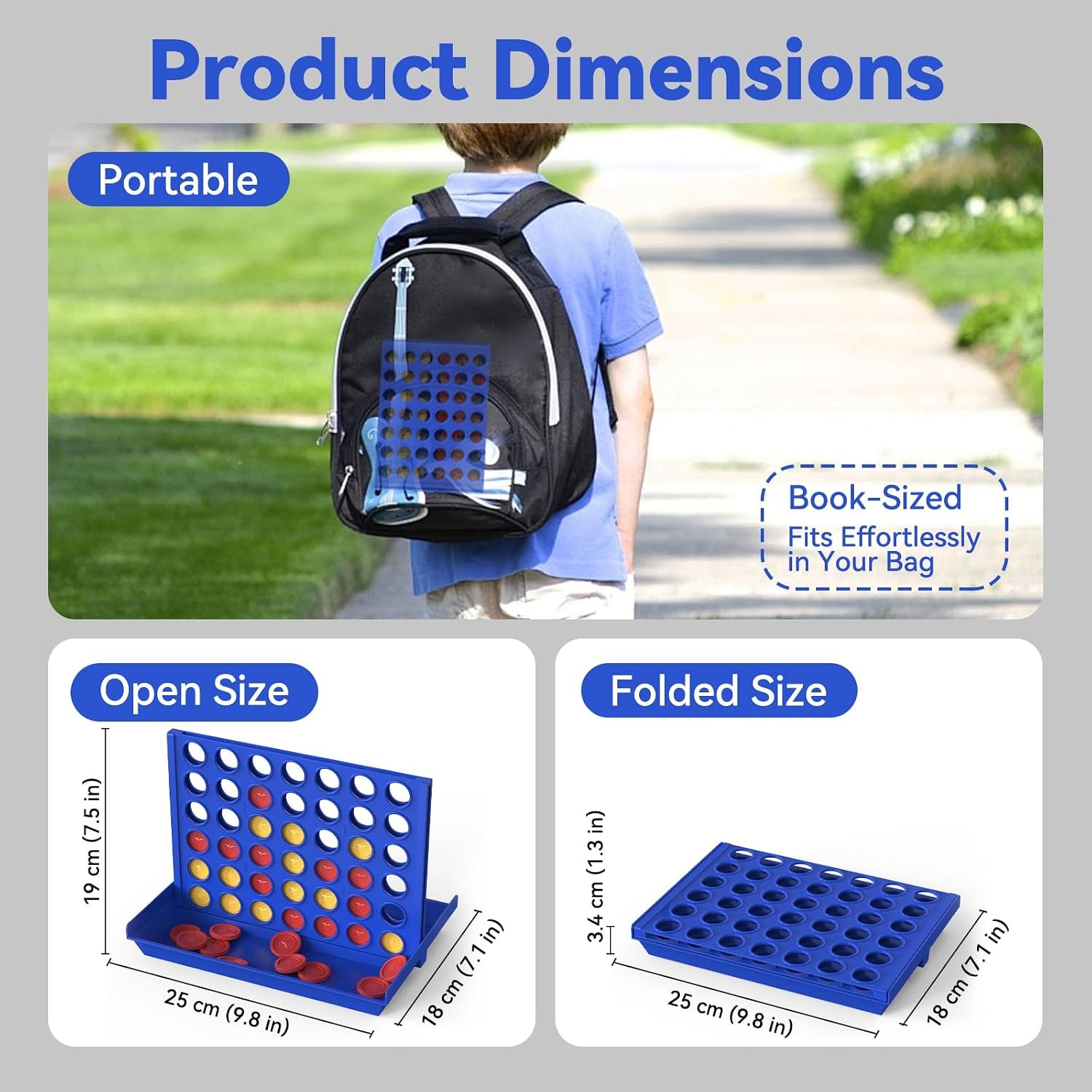
Fifth, size and weight. This one is 25 x 19 x 0.1 cm and 0.26 kg. It packs flat, slides into a bag and does not add noticeable weight to luggage. If you want the best portable connect game for holidays or the car, those numbers are the ones to look at.
Making it last
There is not much maintenance involved. Wipe the grid and the discs with a slightly damp cloth when they get grubby, and dry them properly before putting the set away. Do not put the pieces in a dishwasher and do not leave them soaking, since heat and long water exposure are not kind to plastic.
Storage is really about the discs. Keep them in the tray or tip them into a small zip bag inside the box. Count them occasionally. The six spares buy you some grace, but if you lose twelve counters over two years without noticing, the game stops working properly.
The grid itself should be stored flat or standing. Avoid putting heavy things on top of it, since a 0.1 cm thick panel does not love being crushed under a stack of hardbacks.
A few ways to keep it fresh
Once everyone in the house knows the basic game, a couple of variations keep it alive. Timed rounds, where each player has five seconds to move, change the feel completely and lead to a lot of mistakes and laughing. Blind-ish play, where you look away while the other person moves, makes it harder to track. Team play, with two people per side talking it through, works nicely at a party.
You can also play a simple ladder across a weekend, with points for wins and a draw counting as half. Children take that far more seriously than you would expect, and it turns ten short rounds into an event.
The short version
This is a two-player line game for ages 3 and up, with a stand-up grid, a catch tray, 42 discs and 6 spares. It is plastic, it weighs 0.26 kg, it measures 25 x 19 x 0.1 cm, and it needs no assembly, no batteries and no instruction manual.
What you are actually buying is a game that a very young child can play on day one and still enjoy at twelve, that takes three minutes a round, that fits in a bag, and that survives being left out on a table. For a household with mixed ages, or a classroom, or a car boot that needs something for the next long drive, that combination is hard to beat.