
The complete guide
How to Choose an RC Drift Car That Actually Drifts
The problem with most remote control cars
Buy a cheap remote control car and you usually get the same experience. It goes fast in a straight line, then you turn the wheel and it ploughs on, hits the skirting board, and stops. After ten minutes the novelty wears off, because there is nothing to get better at. Straight-line speed is a one-trick party piece, and in a normal house there is rarely enough straight line to use it.
A drift car solves that. It gives you something to practise. The car is set up to lose grip at the back on purpose, and your job is to catch it and hold it through the corner with the throttle and a bit of steering. Getting that right takes a few goes. Getting it right consistently takes a few sessions. That is the difference between a toy that lives in a cupboard and one that keeps coming out.
How drifting works on a small car
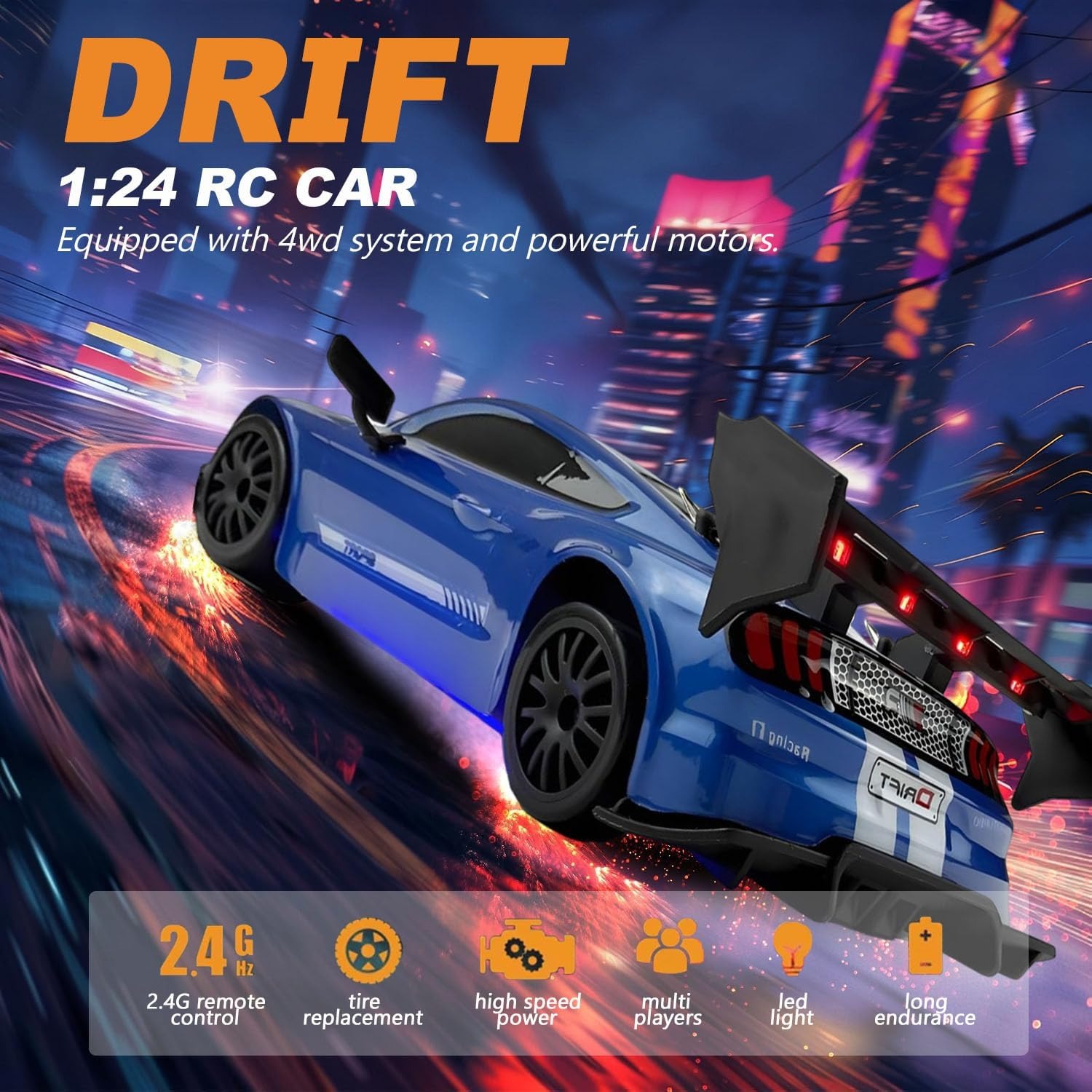
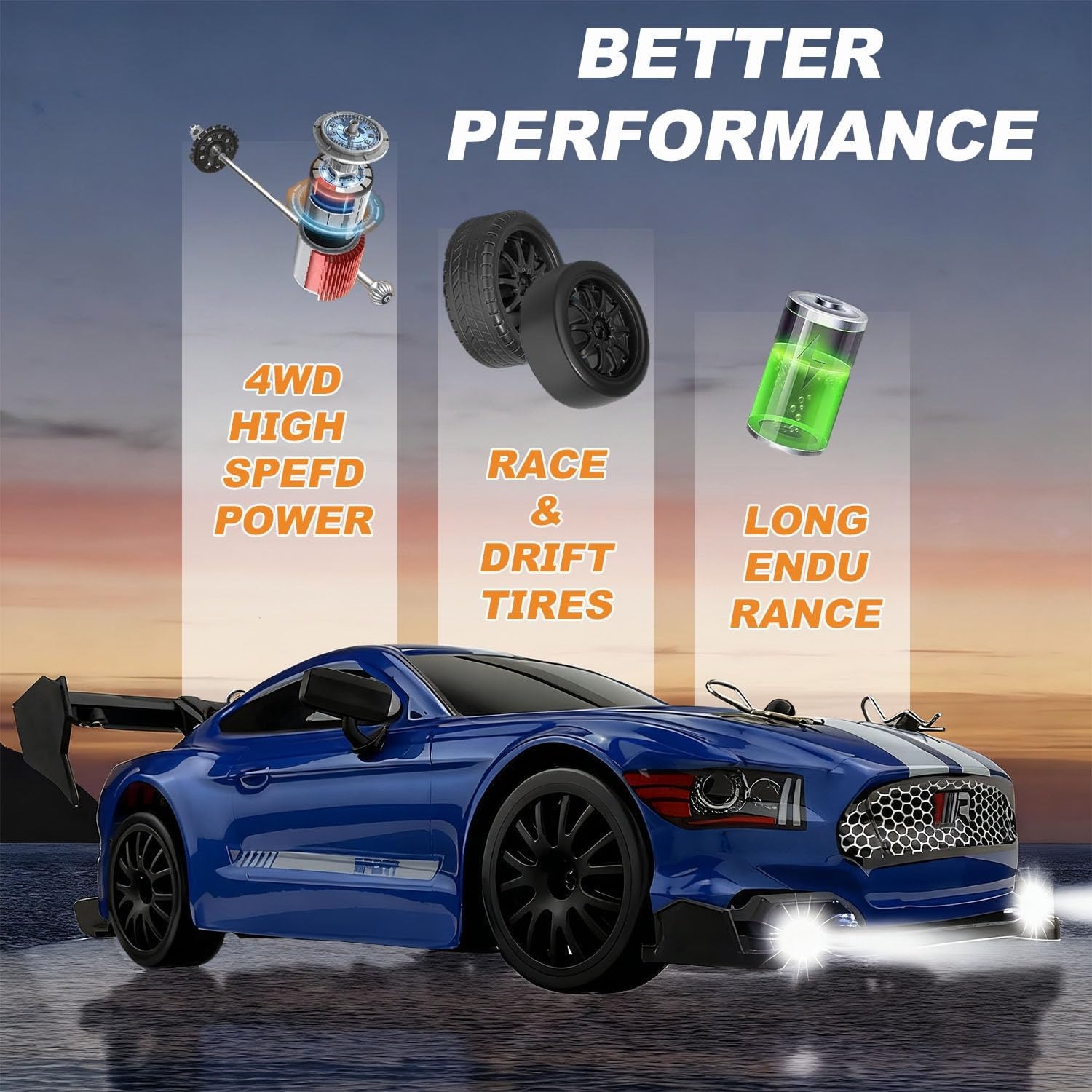
Two ingredients make a car slide in a controlled way. The first is drive to all four wheels. If only the rear wheels pull, a slide tends to end in a spin, because the front has nothing pushing it round. With four-wheel drive, the front wheels keep dragging the car forward through the slide, which gives you time to steer into it and straighten up on the exit.
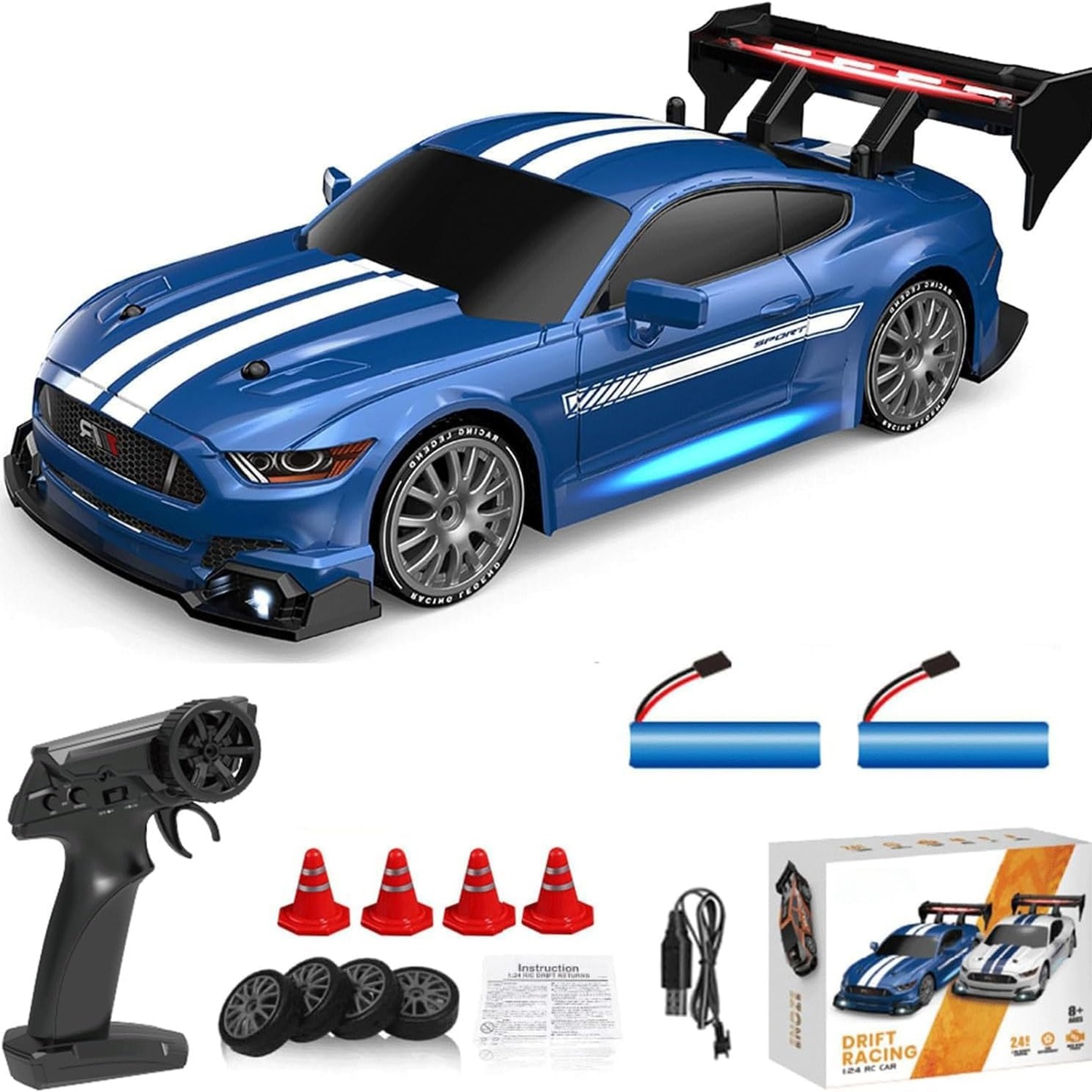
The second ingredient is tyre grip, or rather the lack of it. Drift tyres are harder and smoother than racing tyres, so they break traction early and slide predictably. This TOPSHINE model gives you both sets, which is more useful than it sounds. Grip tyres turn it into a tidy 1:24 rc racing car for chasing lap times around a hallway loop. Drift tyres turn the same car into something you steer with the throttle. One purchase, two different hobbies.
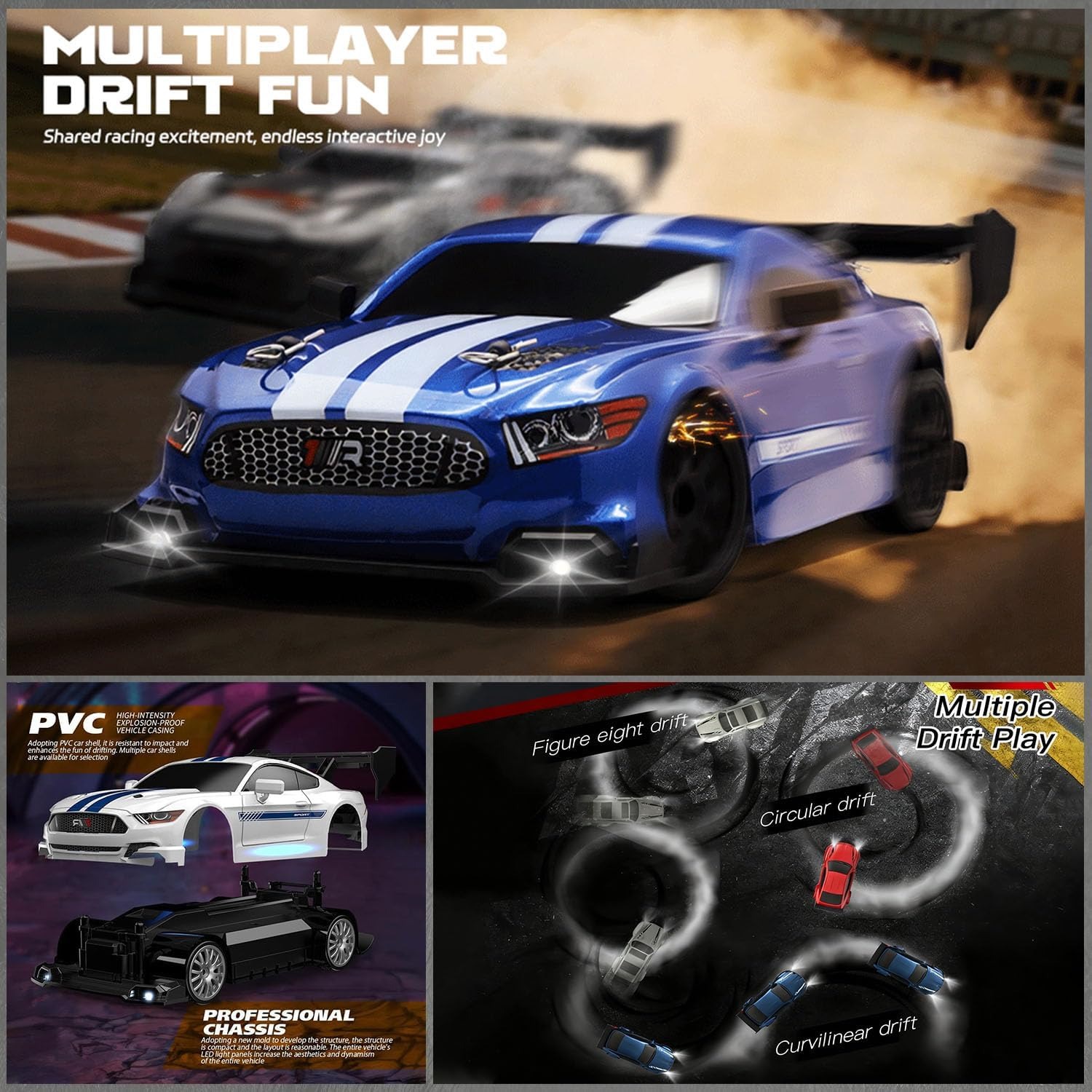
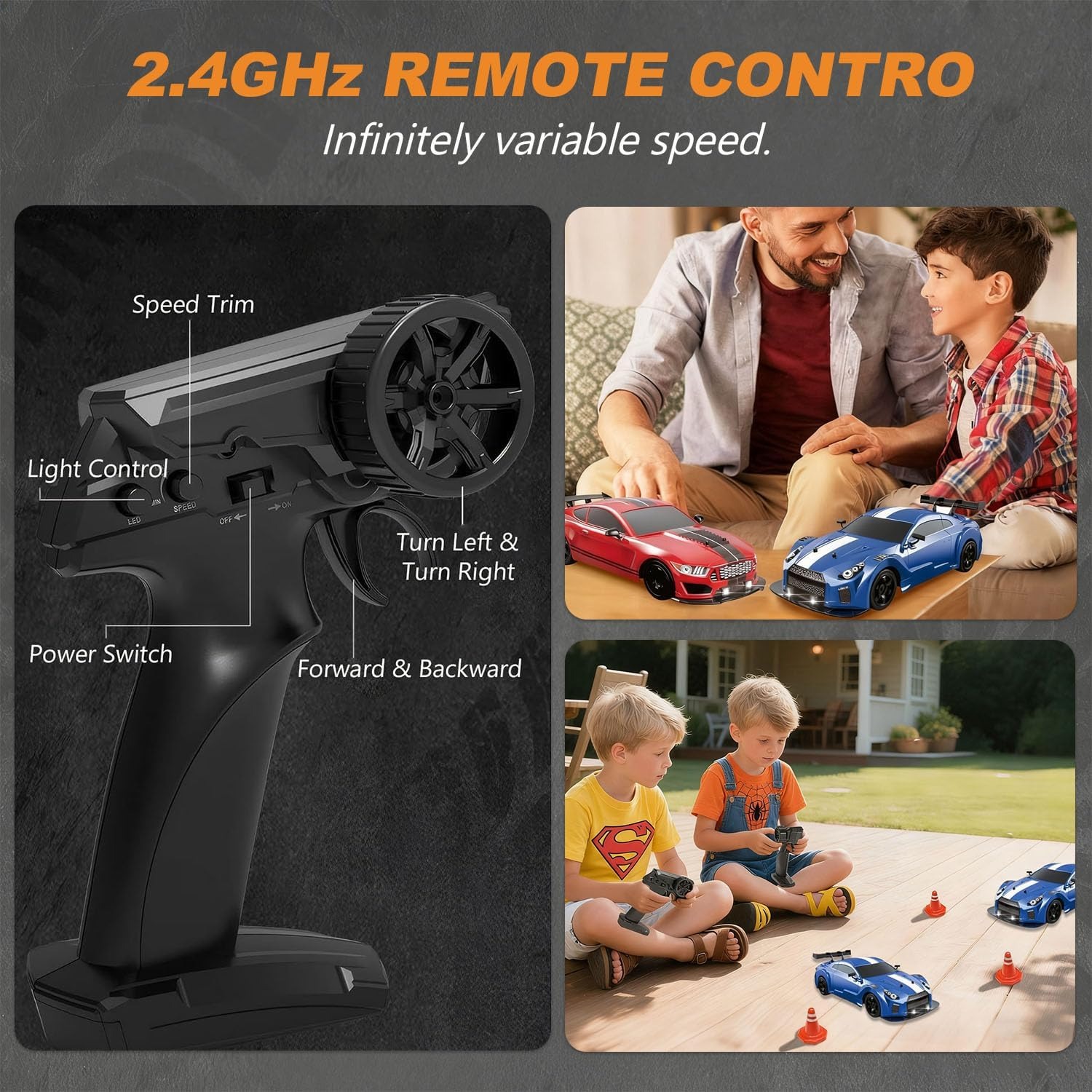
The 2.4GHz radio matters more than most people expect. Older toy cars used fixed frequencies, which meant two cars in the same room would fight over the signal and one would go haywire. A 2.4GHz system with automatic pairing locks each controller to its own car. Switch both on and they find each other. For a household with two children, or a birthday party where someone brings their own car, that is the feature that keeps everyone driving instead of arguing.
Who this one suits
The manufacturer recommends ages 5 and up, and that feels about right. A five or six year old will start by flooring it and crashing into things, which is a perfectly good way to learn. Within a session or two most of them work out that a short burst of throttle plus a flick of steering produces a slide, and that is when it gets genuinely absorbing.
Older children and teenagers tend to get into the track-building side. Four barricades come in the box, and they are enough to mark a corner or a gate. Everything else gets improvised from books, shoes, cushions and chair legs. Laying out a course and then trying to run it cleanly is where a lot of the play value sits, and it costs nothing extra.
Adults buy these too, usually as a cheap way to find out whether drifting appeals before committing to a hobby-grade chassis that costs many times more. At 1:24 scale it fits on a desk, looks decent on a shelf, and can be run in a lounge room without clearing the furniture. If the bug bites, you will know. If it does not, you have not lost much.
Choosing the right size and space
Scale decides where you can drive. A 1:10 car needs a car park or a tennis court. A 1:24 car like this one, at just over 21 cm long, is at home indoors. A hallway, a kitchen floor, a tiled patio or a flat driveway all give enough room to build speed and set up a corner.
Think about your surfaces before you buy any drift car. Smooth and hard is what you want: floorboards, tiles, vinyl, sealed concrete, smooth bitumen. Deep carpet acts like mud and kills the slide. Grass and gravel are worse, since loose material gets into the wheels and axles. Short-pile carpet or a rug can work for grip-tyre running, but drifting really wants a hard floor.
If you only have carpet, that is not a dealbreaker, it just means you run the grip tyres and treat it as a racing car. The option is there, which is exactly why having both sets in the box is worth something.
Power, charging and batteries
This one charges from a USB cable that comes with it, and the controller takes AA batteries, which are also included. That combination matters on gift day. There is nothing to run out and buy, nothing to borrow from the TV remote, and no shop trip before the first drive.
Build a simple charging habit. Use the supplied cable rather than the fastest charger in the house. Unplug it once it is done instead of leaving it connected for days. Let the car cool for a few minutes after a hard run before you plug it in again. None of this is complicated, and all of it makes the battery last longer than it otherwise would.
Run time on small cars like this is best described as a session, not an afternoon. Many families settle into a rhythm of driving, charging over dinner, then driving again. If you want back-to-back running, plan around the charge rather than being surprised by it.
Keeping it in good shape
Most RC cars die from neglect rather than crashes. The usual killer is hair and grit wound around the axles, which slowly chokes the drivetrain until the wheels will not turn freely. Two minutes with your fingers and a pair of tweezers after each outdoor run prevents it.
Wipe the body with a dry or lightly damp cloth, never run the car under a tap, and keep it out of puddles. The shell is PVC over an ABS body, which handles knocks well, and the edges are rounded so nobody scratches a hand picking it up mid-crash. Store it somewhere cool and dry out of the sun, since heat and sunlight are hard on both plastic and batteries. If it is going into a cupboard for months, pull the AA batteries out of the controller so they cannot leak inside it.
Keep the spare tyre set somewhere obvious. A small zip bag taped inside the box lid works. Loose tyres have a talent for vanishing, and once they are gone you have lost half of what makes this car interesting.
A few honest expectations
This is a toy-grade car, and it behaves like one. It is built for smooth surfaces, not jumps, kerbs or rough ground. Drop it off a step and something may break. Driven in the spaces it is designed for, it will take plenty of wall taps and keep going.
Drifting also takes practice. The first few minutes usually involve spinning out, over-correcting and hitting the skirting board. That is normal. The control comes from short throttle inputs rather than holding it flat, and once that clicks the car starts doing what you want. Give it a session before deciding whether it works for you.
The short version
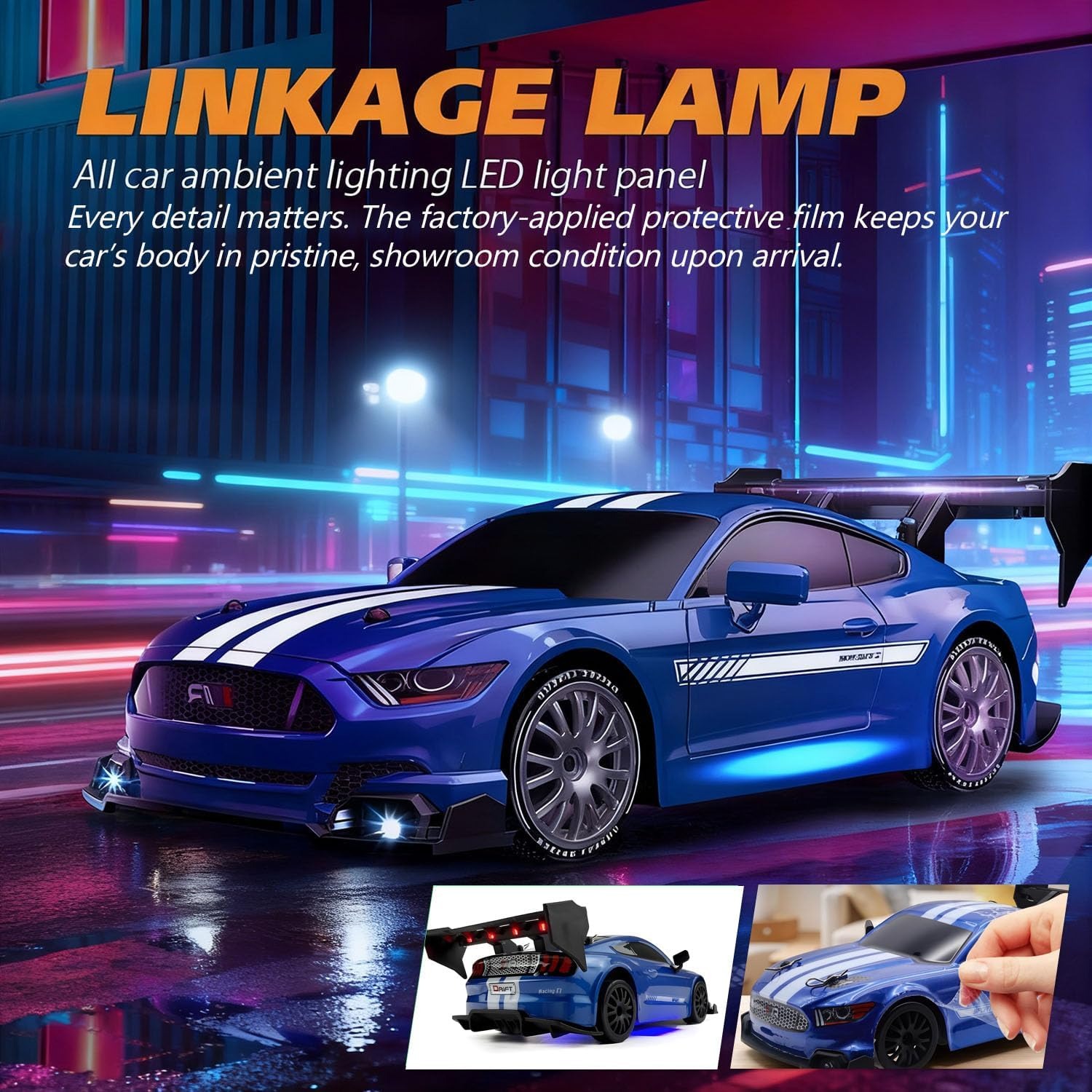
If you want a remote control car that stays interesting past the first week, pick one that rewards skill. This TOPSHINE 1:24 drift car does that through four-wheel drive, a stable 2.4GHz link that lets several cars run together, and two sets of tyres so it can race on grip or slide on drift tyres. Front lights make evening runs in the hallway more fun, four barricades get a course started, and because the batteries and charging cable are included you can drive it the day it lands. Keep it on smooth floors, keep grit out of the wheels, and it will earn its place on the shelf between sessions.